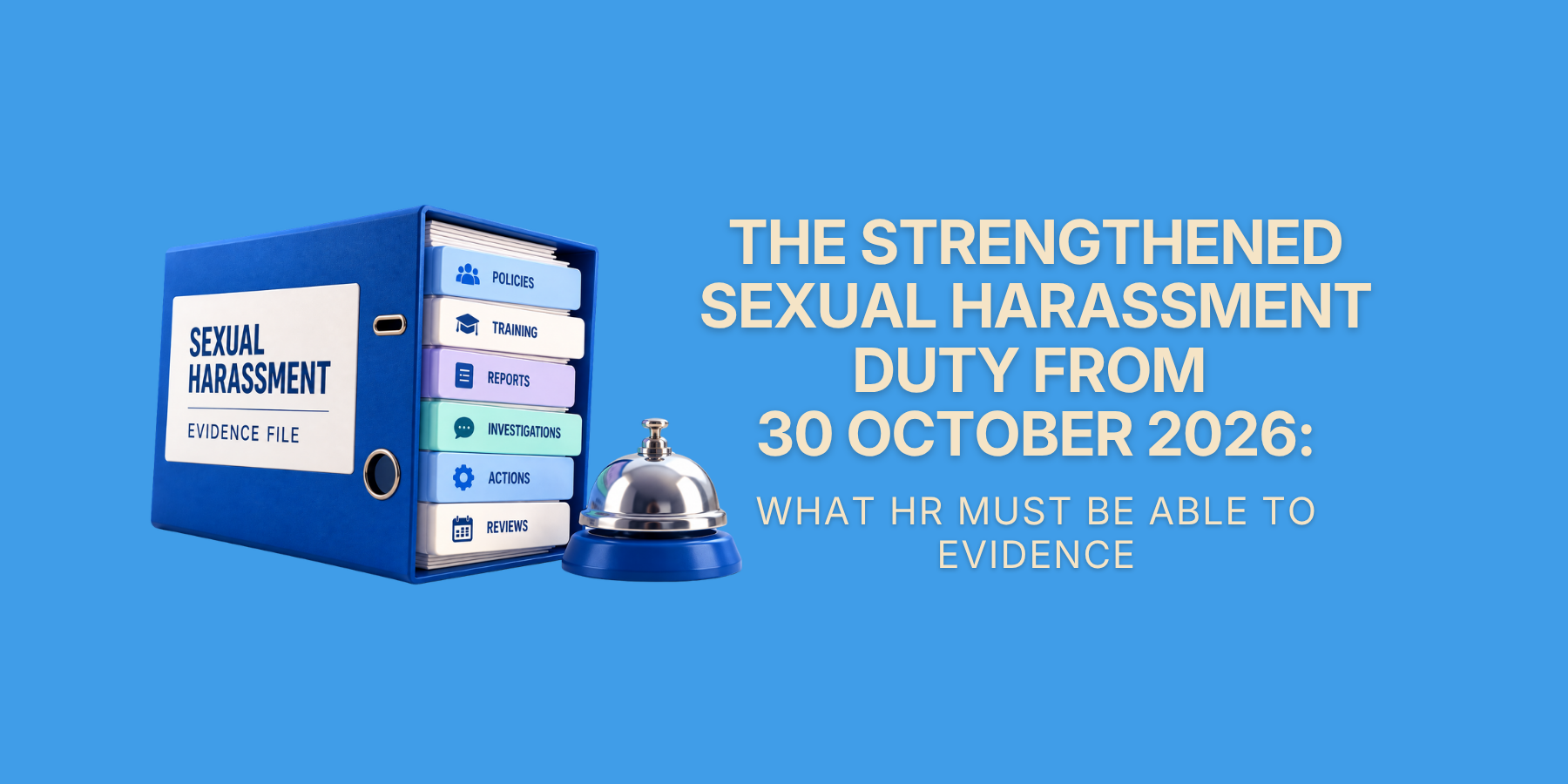
The Strengthened Sexual Harassment Duty from 30 October 2026: What HR Must Be Able to Evidence
Published 25 September 2026
Key Takeaways
- From 30 October 2026 you must take all reasonable steps to prevent sexual harassment. Section 20 of the Employment Rights Act 2025 inserts the word "all" into section 40A(1) of the Equality Act 2010, raising the preventative duty that has applied since 26 October 2024.
- The 30 October date is announced, but it is not yet law. As at 25 September 2026, sections 20, 21 and 22 of the Act are enacted but not in force, and no commencement regulations for them have been made. The government's employer guidance (updated 17 September 2026) and Acas both give 30 October 2026, so treat it as your deadline.
- Harassment of your staff by customers, clients, patients and contractors becomes your legal liability. New section 40(1A) to (1C) of the Equality Act makes you liable where a third party harasses an employee in the course of their work and you did not take all reasonable steps to prevent it. It covers sexual harassment and harassment related to age, disability, gender reassignment, race, religion or belief, sex and sexual orientation.
- One incident is enough, and the employee can bring the claim against you directly. There is no "three strikes" rule and no requirement that you knew of earlier incidents, unlike the third-party regime repealed on 1 October 2013.
- "All reasonable steps" is an existing test, and tribunals decide it on evidence. It mirrors the defence in section 109(4) of the Equality Act: you have taken all reasonable steps only if there was no further step you could reasonably have been expected to take, and brief or stale training has failed that test before.
- Start with a written risk assessment that maps where third parties meet your staff. The EHRC says an employer is unlikely to comply with the duty without one. Record the steps you considered and rejected as well as the ones you took, because Acas advises writing down why a step was not reasonable for you.
- A breach can add up to 25% to a sexual harassment award. Under section 124A, when a tribunal upholds a sexual harassment claim it must consider whether you also breached the preventative duty and can uplift the compensation. The EHRC can enforce the duty even where no incident has occurred.
- There is no official list of required steps yet. Section 22 lets ministers specify steps in regulations under a new section 40B, but none have been made and the government expects them in 2027/28 after consultation. The EHRC technical guidance has not yet been updated for the 2025 Act.
- Two related changes are already in force. Reporting sexual harassment has been a protected whistleblowing disclosure since 6 April 2026, and from 1 October 2026 a harassment claim can be brought up to six months after the act, not three.
- Our HR compliance software keeps the records this duty is proven on. WPC HR's HR compliance software stores risk assessments, policy acknowledgements, training records and complaint files in one structured, timestamped file per worker, and our sponsor licence compliance audit tests that file before a tribunal or a compliance officer does.
Introduction
On 30 October 2026, two changes to the Equality Act 2010 are due to take effect. The duty to prevent sexual harassment of your employees rises from "reasonable steps" to "all reasonable steps". And you become liable when a customer, client, patient, contractor or member of the public harasses one of your staff and you had not done everything reasonable to stop it. Both changes come from the Employment Rights Act 2025, and both are won or lost in the same way: on what your records show you did before anything went wrong.
This post settles three questions an HR team needs answered before that date. What does "all reasonable steps" require in practice? Are customers and clients now your problem? And what evidence would persuade a tribunal that you did enough? The short answers are: more than a policy and a yearly e-learning module; yes, for harassment related to any of seven protected characteristics; and a dated, reviewed file showing that risks were identified, acted on and revisited.
Be clear about status. As at 25 September 2026, the harassment provisions are enacted but not yet in force. The government has announced 30 October 2026 and Acas has built its guidance around that date, but the commencement regulations that will switch the provisions on had not been made when we checked legislation.gov.uk today. Throughout this post we say which rules are already law, which are enacted and waiting, and which do not exist yet.
The changes apply in England, Wales and Scotland, not Northern Ireland. This post leaves the full Employment Rights Act timetable, tribunal procedure, confidentiality agreements and unfair dismissal to other posts, and deals only with the harassment duties and the evidence behind them.
Where the Law Stands on 25 September 2026
Most commentary on this subject blurs three layers of law. Keep them apart, because each carries a different consequence today.
| Layer | Provision | Status and date | What it means for you now |
|---|---|---|---|
| In force now | Section 40A Equality Act 2010: duty to take reasonable steps to prevent sexual harassment of employees | In force since 26 October 2024, inserted by the Worker Protection (Amendment of Equality Act 2010) Act 2023 | Already enforceable by the EHRC and through the compensation uplift. It already covers sexual harassment by third parties. |
| In force now | Section 124A Equality Act 2010: compensation uplift | In force since 26 October 2024 | Up to 25% extra on a successful sexual harassment claim where the duty was breached. |
| In force now | Section 43B(1)(da) Employment Rights Act 1996, inserted by section 23 of the 2025 Act: sexual harassment as a qualifying disclosure | In force since 6 April 2026 (SI 2026/323) | A worker who reports sexual harassment is protected from detriment and dismissal for doing so. |
| Enacted, due 30 October 2026 | Section 20 of the 2025 Act: "all reasonable steps" in section 40A(1) | Prospective. Date announced; commencement regulations not yet made | Prepare to the higher standard now. |
| Enacted, due 30 October 2026 | Section 21 of the 2025 Act: new section 40(1A) to (1C), harassment by third parties | Prospective. Date announced; commencement regulations not yet made | Employees gain a direct tribunal claim for third-party harassment related to any of seven protected characteristics. |
| Not yet made | Regulations under new section 40B (inserted by section 22) specifying steps that count as reasonable | Section 22 prospective. No regulations made. Government expects them in 2027/28, after consultation | No mandatory list exists. You decide what is reasonable for your organisation and record why. |
The commencement point, spelled out
Sections 20, 21 and 22 did not come into force on Royal Assent, so each needs commencement regulations. The most recent commencement regulations under the Act, SI 2026/954, were made on 1 September 2026 and bring in only the longer tribunal time limits, from 1 October 2026. Nothing we found commences the harassment provisions, and legislation.gov.uk still marks all three, including the power in section 22, as prospective.
In practice, 30 October 2026 is the government's stated plan, Acas has written its guidance around it, and you should treat it as your deadline. Do not describe the new duties as law in a policy, contract or staff communication until the regulations exist. One practical warning: legislation.gov.uk can lag behind. It still shows the time limit provision as prospective even though SI 2026/954 commences it, so search for the statutory instrument itself rather than relying on the annotation on a section.
What "All Reasonable Steps" Adds to the Duty You Already Have
Since 26 October 2024, section 40A of the Equality Act 2010 has required you to take reasonable steps to prevent sexual harassment of your employees in the course of their employment. Sexual harassment here means unwanted conduct of a sexual nature that has the purpose or effect of violating someone's dignity or creating an intimidating, hostile, degrading, humiliating or offensive environment for them (section 26(2)). The duty is anticipatory. It does not wait for a complaint.
Section 20 of the 2025 Act changes one word. The effect is to line the positive duty up with a standard employers already face. Under section 109(4), an employer sued over harassment by one of its own staff escapes liability only if it took all reasonable steps to prevent it. The Department for Business and Trade's factsheet on the change says the aim is to remove any perception that the preventative duty was the lower bar.
Because the words are now identical, the existing approach to section 109(4) is the best guide to how tribunals will read the strengthened duty. The EHRC technical guidance summarises that approach:
- You have taken all reasonable steps only if there were no further steps you could reasonably have been expected to take (paragraph 3.50).
- A tribunal can find that a step was reasonable even if it would not have prevented the harassment in question (paragraph 3.52).
- You may weigh a step's likely effect against its time, cost and disruption, but a step that would work can outweigh those costs (paragraph 3.53).
- Investigating and disciplining after the event is not enough on its own, although it can show your policy is taken seriously (paragraph 3.54).
- Training that staff attended but did not absorb can count against you. The guidance cites Allay (UK) Ltd v Gehlen (UKEAT/0031/20), where the Employment Appeal Tribunal upheld a finding that stale training did not satisfy the defence (paragraph 3.56).
Acas's guidance on the sexual harassment change puts the shift in three plain points: take all of the steps that are reasonable for your organisation rather than some of them; focus on preventing harassment rather than reacting to incidents; and apply steps across the whole organisation, not only to the people involved in a past incident. It confirms the duty covers online as well as in-person harassment, and that larger or more complex organisations are likely to need to do more.
| Question | Reasonable steps (since 26 October 2024) | All reasonable steps (announced for 30 October 2026) |
|---|---|---|
| The test | Did you take steps that were reasonable? | Was there any further reasonable step you did not take? |
| Room to pick and choose | Taking some reasonable steps could arguably satisfy the duty | Leaving out a step that was reasonable for you is a breach |
| Benchmark | A new standard with little case law | Same wording as the section 109(4) defence, which has an established body of case law |
| Who enforces | The EHRC, and the tribunal through the section 124A uplift | Unchanged |
| Standalone employee claim for breach of the duty | No | Still no. A claim for the harassment itself must succeed first |
| Third-party sexual harassment | Covered by the preventative duty (EHRC paragraph 3.85) | Still covered, and third-party harassment also becomes a direct claim under section 40(1A) |
How the duty is enforced
There is still no standalone claim for breach of section 40A. It is enforced in two ways. First, the EHRC can investigate, issue an unlawful act notice requiring an action plan, enter a binding agreement or seek an injunction under the Equality Act 2006, and it does not need an incident to have happened before it acts (EHRC paragraphs 3.36 and 3.37). Second, where a tribunal upholds a sexual harassment claim and awards compensation, section 124A requires it to consider whether you also breached the preventative duty, and lets it add an uplift of up to 25% reflecting the extent of the breach.
The uplift is a percentage of the whole compensation award, which can include loss of earnings, injury to feelings and personal injury. On a £40,000 award, the maximum uplift is £10,000. Section 124A applies to any contravention of section 40 that involved sexual harassment, and the new third-party provision sits inside section 40, so on the wording of the Act a successful claim of sexual harassment by a customer or client can attract the uplift too.
Third-Party Harassment: Are Customers and Clients Now Your Problem?
Yes. Section 21 of the 2025 Act inserts three subsections into section 40 of the Equality Act 2010. An employer must not permit a third party to harass one of its employees. It "permits" harassment only if the third party harasses the employee in the course of their employment and the employer failed to take all reasonable steps to prevent it. A third party is anyone other than the employer itself or one of its employees.
That definition is wide. Acas's guidance on third-party harassment lists customers, clients, service users such as patients or pupils, self-employed consultants, contractors and tradespeople, people at conferences and events, and members of the public in shared spaces, whether the harassment happens in person or online. In most organisations it will also include your clients' and suppliers' staff, agency workers engaged through someone else, and anyone your people deal with while working on another organisation's premises.
| Question | Position under new section 40(1A) to (1C) |
|---|---|
| Types of harassment covered | All three forms in section 26: harassment related to a relevant protected characteristic, sexual harassment, and less favourable treatment for rejecting or submitting to sexual or sex-related harassment |
| Protected characteristics covered | Age, disability, gender reassignment, race, religion or belief, sex and sexual orientation |
| Not covered | Pregnancy and maternity, and marriage and civil partnership, which are not relevant protected characteristics for harassment under section 26(5) |
| Who is protected | Your employees, in the Equality Act's wide sense, which includes workers engaged to do the work personally. Job applicants are not covered by the new subsections |
| Where | In the course of employment, which can include client sites, events, travel and online contact |
| Prior incidents or knowledge | Not required. A single incident can found a claim |
| Who can enforce | The employee, by an employment tribunal claim, and the EHRC under its enforcement powers |
| Statutory exceptions | None in the Act. There is no carve-out for overheard conversations |
| Where it applies | England, Wales and Scotland. Not Northern Ireland |
The missing knowledge requirement is the biggest difference from the previous regime. Until 1 October 2013, the Equality Act made employers liable for third-party harassment only once they knew of two earlier incidents. That rule was repealed in 2013, and in Unite the Union v Nailard (2018) the Court of Appeal confirmed that the repeal left nothing in its place. The new provision has no threshold at all.
Nor is there a carve-out for remarks an employee merely overhears. Parliament's Joint Committee on Human Rights raised the point and the government declined, relying on two existing safeguards. Conduct counts as harassment only if it is reasonable for it to have that effect, taking into account the employee's perception and the other circumstances (section 26(4)). And tribunals must balance freedom of expression under Article 10 of the European Convention on Human Rights. The government's factsheet is explicit that employers are not expected to foresee the wholly unforeseeable or police customers' private conversations, and that what you can reasonably do about third parties is more limited than what you can do about your own staff.
Where third parties meet your staff
Map the points of contact before you try to control them. The EHRC's list of risk factors (paragraphs 4.10 and 4.11) is a sound starting point: customer-facing duties, lone and night working, working alone with a third party, alcohol, events and conferences, travel and overnight stays, secondments and work at other locations. If your staff work on a client's premises, the client's employees are third parties to you, and your ability to prevent harassment depends largely on what your contract with that client says. Our guide to right to work records for contractors covers the file for workers placed on third-party sites, and the same contract review can pick up harassment terms.
| Contact point | Typical risk | Controls to consider | Record that shows it |
|---|---|---|---|
| Front desk, shop floor, bar or restaurant | Verbal, sexual or racial abuse from customers | Conduct notices, staffing at peak times, a code word, authority to refuse service | Risk assessment entry, photo of notices, rota, incident log |
| Care, health and home visits | Harassment by service users or relatives, often while working alone | Pairing or check-in calls, care plan note on known behaviour, withdrawal protocol | Lone working log, care plan flags, check-in records |
| Client sites and secondments | Harassment by the client's staff | Contract clause on the client's anti-harassment arrangements, a named contact, a right to withdraw staff | Signed contract clause, site induction record |
| Events, conferences and travel | Alcohol, overnight stays, blurred boundaries | Event briefing, a named lead on site, limits on hospitality | Briefing email, attendee acknowledgement, event risk note |
| Phone, email, social media and video calls | Online abuse from customers or the public | Recorded call messages, a block and escalate procedure, moderation | Procedure document, log of blocked accounts |
| Contractors and suppliers on your premises | Harassment by visiting tradespeople or supplier staff | Supplier code of conduct, sign-in with site rules, a right to remove | Supplier terms, sign-in records, removal records |
The Evidence File: What a Tribunal Would Expect and the Record That Proves It
At a hearing the argument is framed around your steps, but it is decided on documents. The claimant's representative will ask what you did, when, for whom, and how you knew it worked. The table below sets each step against what a tribunal is likely to expect, drawn from the EHRC technical guidance and Acas, and the record you would produce. It is the same approach we took for exploitation allegations in our post on modern slavery and sponsor licences: the file is the argument.
| Step | What a tribunal would expect | The record that proves it |
|---|---|---|
| Risk assessment | A specific assessment of sexual harassment risk and other harassment risks, including third-party contact points, reviewed regularly (EHRC 4.10 to 4.13) | Dated assessment with a named author, a map of contact points, version history and review dates |
| Action plan and owner | Steps to address each risk, how they are monitored, and a named person responsible (EHRC 4.14 and 4.15) | Action plan with owners and deadlines, senior sign-off, progress updates |
| Policy | A policy that defines each form of harassment separately, covers third parties and states the consequences (EHRC 4.16 to 4.19) | Current policy with version number and approval date, record of consultation with the union or staff representatives, earlier versions kept |
| Communication | Every worker knows the policy exists and how it applies to them | Induction checklist, acknowledgement per worker, publication date, reminders sent |
| Training for all staff | Training tailored to your workplace, covering all three forms of harassment and victimisation, refreshed at intervals (EHRC 4.37, 4.39 and 4.40) | Training record per worker with dates, content version, completion and refresh due date |
| Training for managers and handlers | Managers know how to receive, escalate and investigate a complaint, including third-party scenarios where relevant (EHRC 4.38, 4.39 and 4.41) | Manager training records, list of trained contacts, scenario content |
| Reporting routes | More than one way to report, including a route that bypasses the line manager and ideally an anonymous option (Acas; EHRC 4.35) | Published reporting routes, anonymous channel log, announcement to staff |
| Complaint handling | Prompt, fair investigation, with support for the complainant and protection from victimisation | Case file: dates, investigator, notes, interim measures, decision and reasons |
| Outcomes | The complainant told what action was taken where appropriate, with a recorded decision on disclosure (EHRC 4.83 to 4.86) | Outcome letter, disclosure decision note, follow-up and reintegration plan |
| Central register | All complaints, formal and informal, logged in enough detail to spot trends (EHRC 4.29) | Register showing date, area, roles, characteristic, category and outcome, with restricted access |
| Third-party terms | Clients, customers, venues and suppliers told the standard you expect and the consequences (Acas) | Contract clauses, booking terms, supplier code of conduct, customer-facing notices |
| Third-party incidents | A set response: warning, refusal of service, ban, police report, sharing information with other sites (EHRC 4.18) | Incident log with action taken, ban list, correspondence with the client or customer |
| Monitoring | Evidence the steps work, not just exist: staff surveys, exit interviews, reports compared with survey data (EHRC 4.29 to 4.31) | Survey results, exit interview summaries, trend report to leadership |
| Review | Annual policy review, and review after an incident or a change (EHRC 4.32) | Review log with dates, findings and changes made |
| Steps not taken | Reasons for rejecting a step, or for applying it to some teams only (Acas) | Decision note: step considered, date, reason, who decided |
Record the steps you decided against
This is the record most employers do not keep, and it matters most under the new wording. A tribunal will ask whether there was a further reasonable step you did not take. If you considered body cameras, extra security staff, a second person on night shifts or an external reporting line and decided against them, that decision is evidence. Acas advises recording why you judged a step not reasonable, including where you applied it to some teams only. Without the note, a tribunal sees an omission. With it, the tribunal sees a judgement it can assess.
Keep the note short: the step, the date, the risk it addressed, the reason (cost, practicality, or a better alternative already in place) and who decided. Revisit it at each review, because a step that was unaffordable last year may not be now, and a step later specified in regulations under section 40B will stop being optional.
Contracts and terms with clients, venues and suppliers
Third-party harassment is where contracts do real work. Acas suggests reviewing client, customer and supplier contracts and terms so they include the relevant parts of your policy, and making sure individual transactions, such as hotel bookings, carry up-to-date terms and conditions. Useful clauses include an obligation on a client to have its own anti-harassment arrangements for your staff on its site, a named contact and a timescale for dealing with complaints, your right to withdraw staff, and, for customers and service users, a conduct standard and a right to refuse or end the service. Where agency workers are involved, the EHRC expects the agency and the hirer to agree in writing who handles complaints (paragraphs 4.42 to 4.47).
Keep the signed versions. A clause that appears only in a template adopted after the incident proves nothing about the date that matters.
Complaints, outcomes and data protection
A central complaints register is one of the strongest pieces of evidence you can hold, because it shows both that you knew what was happening and what you did about it. The EHRC recommends logging informal complaints as well as formal grievances (paragraph 4.29), and warns against reading a low number of complaints as a low level of harassment (paragraph 4.31). The register must comply with UK GDPR: tell workers in your privacy notice that the data will be held, restrict access and record your lawful basis. The same care applies to telling a complainant what action was taken against a harasser. The EHRC says disclosure will often be lawful where you have been clear that outcomes may be shared and you act proportionately, and that you should record the decision and your reasons (paragraphs 4.84 to 4.86).
Review Dates: Keeping the Evidence Current
Evidence goes stale. A policy last reviewed years ago, training delivered once at induction, and a supervisor who tells a complainant to "toughen up" are exactly what the Acas and EHRC examples of failure describe. Put review dates in the file and meet them.
| Item | Review at least | Also review when |
|---|---|---|
| Harassment risk assessment | Annually (our recommendation; the EHRC says "regularly") | A new site, a new client contract, a restructure, a new customer-facing service, or any incident |
| Anti-harassment policy | Annually (EHRC 4.32) | The law changes, including commencement of sections 20 and 21 and any section 40B regulations |
| Staff training | At induction, then at a refresh interval you set and record | A policy change, an incident in the team, or a promotion into management |
| Manager and investigator training | At a refresh interval you set and record | Before a manager handles a first complaint |
| Third-party contract terms | At each contract renewal | A third-party incident involving that client, venue or supplier |
| Complaints register and trends | A quarterly report to leadership | A cluster of complaints in one area or team |
| Decisions not to take a step | At each risk assessment review | A change in cost, headcount or risk |
Keep the file long enough to answer a claim: from 1 October 2026, a harassment claim can be brought up to six months after the act complained of, not three, where that act happens on or after that date (SI 2026/954).
Sexual Harassment Is Now a Protected Disclosure
Since 6 April 2026, a disclosure that sexual harassment has occurred, is occurring or is likely to occur has been a qualifying disclosure under section 43B(1)(da) of the Employment Rights Act 1996, inserted by section 23 of the 2025 Act. As with any qualifying disclosure, the worker must reasonably believe it is made in the public interest. A worker who makes it is protected from detriment, and an employee dismissed for making it is treated as automatically unfairly dismissed.
For HR, the practical point is how complaints are handled. A complaint treated as a nuisance, a complainant moved to worse shifts, or a manager who has a quiet word about loyalty can now found a whistleblowing claim alongside the harassment claim. Your complaint file should show that the complainant was supported and not disadvantaged. Our sister firm WorkPermitCloud explains the April 2026 change in its guide to UK employment law changes in April 2026.
Sponsored Workers: Where Harassment Meets Your Sponsor Duties
If you hold a sponsor licence, harassment of a sponsored worker, or a complaint from one, is also an HR records matter that can surface on a compliance visit. Paragraph C1.53 of the sponsor guidance, part 3 (version 08/26, valid from 28 August 2026) makes compliance with wider UK law a sponsor duty, including UK employment law and "ensuring your workers are aware of their employment rights". The guidance does not mention harassment, and it does not say how a harassment complaint or tribunal finding would be treated, so we do not suggest a single complaint puts a licence at risk.
The realistic exposure is the file. Compliance officers may interview sponsored workers (paragraph C7.14), and a worker who has raised a complaint may mention it. You want to be able to show that the worker knew their rights and how to report, that the complaint was logged and handled like any other, and that the worker suffered no detriment. If a complaint leads to a change in a sponsored worker's duties, hours or place of work, check it against your reporting duties before you make it. Our guides to sponsor duties, Appendix D record keeping and preparing for a Home Office compliance visit cover the rest of the file.
How Can WPC HR Help?
The strengthened duty is proven through records: a dated risk assessment, a policy every worker has acknowledged, training with dates, a complaints register and the notes that explain your choices. Our HR compliance software gives each worker one structured file, so policy acknowledgements, training certificates and complaint documents sit alongside the rest of their HR record, and the timestamped compliance report shows you check it regularly. For sponsored workers, our worker rights duty support helps you record that each worker was told their employment rights.
If you hold a sponsor licence, our sponsor licence compliance audit reviews your HR records the way a compliance officer would, and gives you a prioritised list of gaps to close before 30 October 2026.
| Get in touch with our team via our contact page. 📞 Call us: 020 8087 2343 📧 Email: info@workpermitcloud.co.uk 📅 Book a free compliance audit: wpchr.co.uk/sponsor-licence-compliance-audit 🔗 See the platform: wpchr.co.uk/hr-compliance-software-features |
Conclusion
The word "all" looks like a small amendment. In practice it moves the question a tribunal asks from "did you do something sensible?" to "was there anything else sensible you did not do?", and it arrives alongside a new liability for harassment by people you do not employ. Neither question is answered by good intentions. Both are answered by a file.
With five weeks to go, the priorities are clear: a risk assessment that maps third-party contact points, a policy that covers third parties and every form of harassment, a training schedule with refresh dates, more than one reporting route, updated client and supplier terms, and a note of every step you considered and rejected. Watch for the commencement regulations, and for the updated EHRC guidance, which will replace parts of the current version that the new law overtakes.
Glossary
| Term | Definition |
|---|---|
| All reasonable steps | The standard an employer must meet: no further step existed that it could reasonably have been expected to take. Used in section 109(4) and, once section 20 is commenced, section 40A of the Equality Act 2010. |
| Preventative duty | The positive duty in section 40A of the Equality Act 2010 to take steps to prevent sexual harassment of employees, in force since 26 October 2024. |
| Harassment | Unwanted conduct related to a relevant protected characteristic that violates a person's dignity or creates an intimidating, hostile, degrading, humiliating or offensive environment (section 26(1)). |
| Sexual harassment | Unwanted conduct of a sexual nature with the same purpose or effect (section 26(2)). |
| Less favourable treatment | Treating someone worse because they rejected or submitted to sexual or sex-related harassment (section 26(3)). |
| Relevant protected characteristic | For harassment: age, disability, gender reassignment, race, religion or belief, sex and sexual orientation (section 26(5)). |
| Third party | Anyone other than the employer or one of its employees, such as customers, clients, patients, contractors, suppliers and members of the public. |
| Third-party harassment | Harassment of an employee by a third party in the course of their employment. From the announced date, an employer permits it if it failed to take all reasonable steps to prevent it. |
| Section 109(4) defence | The defence to a claim about harassment by an employer's own staff, available where the employer took all reasonable steps to prevent it. |
| Compensation uplift | An increase of up to 25% in sexual harassment compensation where the employer breached the preventative duty (section 124A). |
| EHRC | The Equality and Human Rights Commission, which can enforce the preventative duty and publishes technical guidance on it. |
| Unlawful act notice | An EHRC notice confirming a breach of the Equality Act and requiring an action plan to prevent further breaches. |
| Commencement regulations | A statutory instrument that brings sections of an Act into force on a stated date. |
| Prospective | The legislation.gov.uk label for a provision that has been enacted but is not yet in force. |
| Affirmative procedure | A parliamentary procedure requiring both Houses to approve draft regulations before they are made. Section 40B regulations will use it. |
| Protected disclosure | A qualifying disclosure made in the way the Employment Rights Act 1996 requires, which protects the worker from detriment and dismissal. |
| Detriment | Any disadvantage, such as worse shifts, exclusion or denial of opportunities, imposed because of a protected act or disclosure. |
| Risk assessment | A documented review of where harassment could occur in your organisation and the controls in place to reduce it. |
| Sponsor licence | Permission from the Home Office to employ workers on sponsored routes such as the Skilled Worker route, subject to sponsor duties. |
| Compliance visit | A Home Office check, announced or unannounced, on whether a sponsor is meeting its duties, which can include interviews with sponsored workers. |
| UK GDPR | The UK's data protection regime, which governs how complaint registers and outcome disclosures are handled. |
FAQ
Frequently asked questions
The government has announced 30 October 2026, and Acas and the government's employer guidance both use that date. As at 25 September 2026 the commencement regulations for section 20 of the Employment Rights Act 2025 had not been made, so the change is enacted but not yet in force. Plan to the date, and check legislation.gov.uk for the commencement regulations before relying on it in a policy or contract.
Under the current duty the question is whether you took steps that were reasonable. Under the strengthened duty it is whether there was any further reasonable step you did not take. The new wording matches the section 109(4) defence, so the existing case law on that defence, including findings that brief or stale training is not enough, will guide tribunals.
You can already breach the preventative duty if you failed to take reasonable steps against sexual harassment by customers. From the announced date of 30 October 2026, the employee will also be able to bring a direct claim against you if a third party harassed them in the course of their work and you did not take all reasonable steps to prevent it. You are not liable for the customer's conduct as such, but for your failure to prevent it.
It covers all three forms of harassment under section 26 of the Equality Act 2010. That includes harassment related to age, disability, gender reassignment, race, religion or belief, sex and sexual orientation, as well as sexual harassment. Pregnancy and maternity, and marriage and civil partnership, are not covered by the harassment provisions.
No. The old rule, repealed on 1 October 2013, required the employer to know of two earlier incidents. The new provision has no such requirement, and a single incident can found a claim. What matters is whether you had taken all reasonable steps beforehand.
There is no specific exception for overheard conversations, but conduct only counts as harassment if it is reasonable for it to have that effect in all the circumstances, and tribunals must weigh freedom of expression. The government has said employers are not expected to police customers' private conversations or foresee the wholly unforeseeable. Your duty is to take the steps that are reasonable for your setting.
No. There is no standalone claim for breach of section 40A. An employee must first succeed in a sexual harassment claim; the tribunal must then consider the preventative duty and can increase the compensation by up to 25%. The EHRC can enforce the duty separately, without any incident having occurred.
Up to 25% of the compensation awarded for the sexual harassment, under section 124A of the Equality Act 2010. The uplift reflects how far the employer fell short, so a partial breach attracts a smaller uplift. On a £40,000 award the maximum uplift is £10,000.
Not yet. Section 22 of the Employment Rights Act 2025 allows ministers to specify reasonable steps in regulations under a new section 40B, covering things like assessments, published plans or policies, reporting and complaint handling. None have been made, and the government expects them in 2027/28 after consultation. Even then, meeting the listed steps will not be enough on its own; you must also take any other step that is reasonable for you.
Not necessarily. The EHRC says you should either have separate policies for sexual harassment and other harassment, or one policy that clearly distinguishes between the forms of harassment. Acas suggests considering a standalone policy. Whichever you choose, it should cover third parties, reporting routes and consequences, and carry a review date.
The law does not set a period. The EHRC says training should be refreshed at regular intervals and that you should keep records of who has been trained. Choose an interval that suits your risks, record it, and meet it. The EHRC gives an example where brief training delivered two years earlier was unlikely to satisfy the defence.
The new subsections protect the employer's own employees, in the Equality Act's wide sense, which includes workers engaged to do work personally. Job applicants are not covered by the new third-party provision. A self-employed contractor who harasses one of your employees is a third party, so their conduct is within the duty.
Yes. No employer is exempt from the preventative duty. What counts as reasonable depends on your size, resources, sector and working environment, so a small business will not be expected to take the same steps as a large one. It will still be expected to assess its risks, take the steps that are reasonable for it, and be able to show what it did.