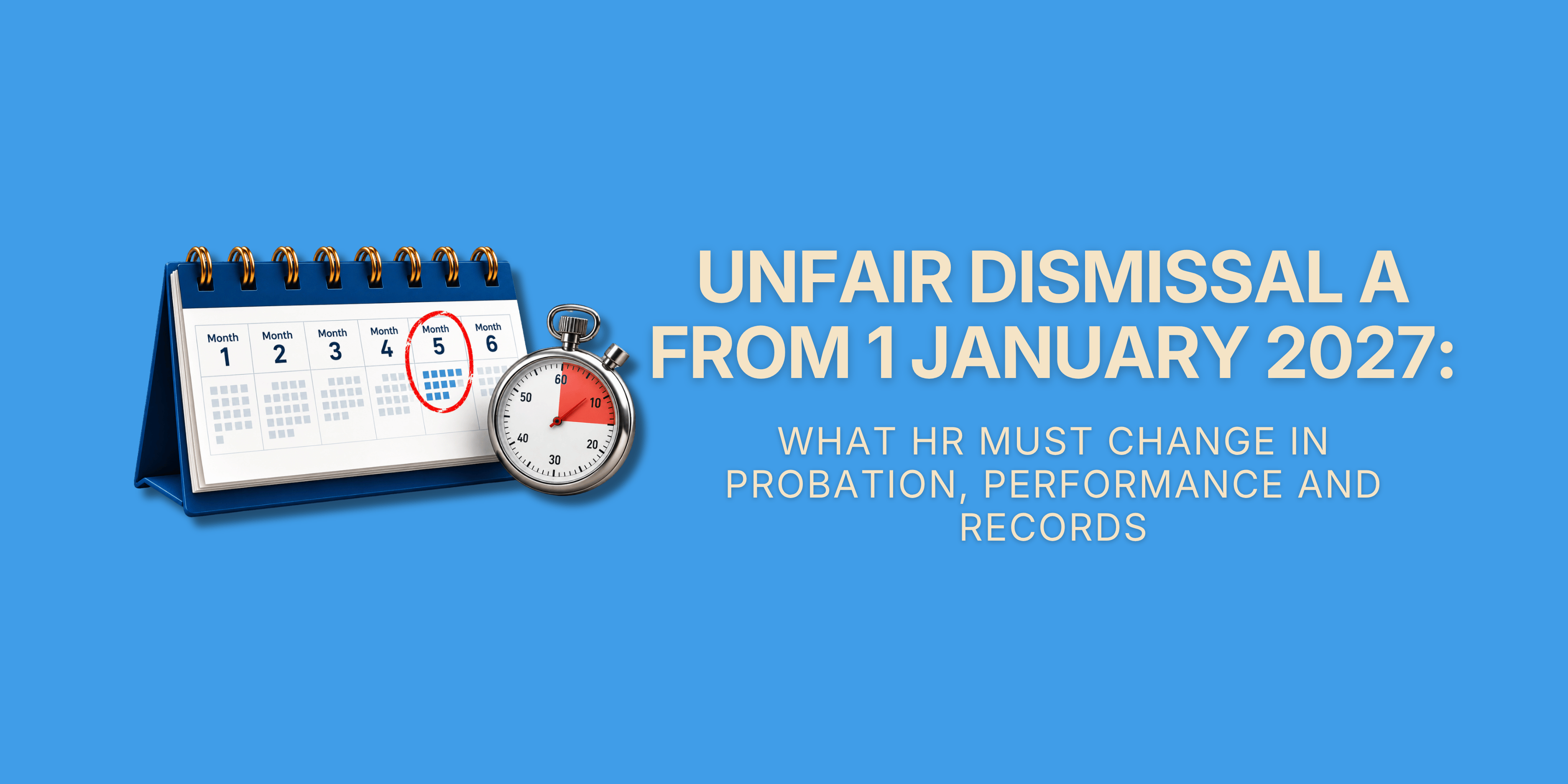
Unfair Dismissal After Six Months from 1 January 2027: What HR Must Change in Probation, Performance and Records
Published 28 October 2026
Key Takeaways
- From 1 January 2027, an employee needs six months' service, not two years, to claim ordinary unfair dismissal. Section 25 of the Employment Rights Act 2025 changes section 108 of the Employment Rights Act 1996, and SI 2026/559 brings it into force on that date in England, Wales and Scotland. Northern Ireland is not affected.
- The effective date of termination decides which rules apply, not the date you decide to dismiss. Regulation 4 of SI 2026/559 applies the new rules wherever the effective date of termination falls on or after 1 January 2027, even if notice was given in 2026, and keeps the old rules where it falls before.
- Anyone who started work on or before 2 July 2026 is protected on 1 January 2027 itself. Continuous employment counts the first day of work, so a period of six months that begins on 2 July 2026 ends with 1 January 2027. Guides that give 1 July 2026 as the cut-off miss one day of starters.
- The statutory week of notice counts as service even when you pay in lieu or dismiss on the spot. Under section 97(2), a dismissal without the statutory minimum notice is treated as ending a week later for the qualifying period. A probation dismissal paid in lieu must therefore take effect at least eight days before the day six months are complete (25 June 2027 for a 4 January 2027 starter), and a summary dismissal from 25 December 2026 is widely read as falling under the new rule.
- There is no cap on the compensatory award where the effective date of termination is on or after 1 January 2027. Section 124 is repealed from that date. Until then the cap is the lower of £123,543 or 52 weeks' gross pay, the figures in force since 6 April 2026. The basic award is unchanged, with a week's pay capped at £751.
- Probation is still a contract term, not a legal regime, so the first six months must be run as a fair process. The final Act creates no statutory probation period, and extending probation does not extend the qualifying period. After six months, a failed probation is judged like any other capability or conduct dismissal, against the 2015 Acas Code, with up to a 25% adjustment to the award for unreasonably failing to follow it.
- Day-one protections do not change, and one more is added. Discrimination claims and automatically unfair reasons such as whistleblowing, pregnancy and health and safety still need no service. From 1 January 2027, a dismissal because of a spent conviction joins that list.
- Employees with six months' service can ask for written reasons for their dismissal from 1 January 2027. Section 92 moves from two years to six months. You must reply within 14 days, and an unreasonable failure costs two weeks' pay.
- Fire and rehire is not law yet, and the government now plans it for March 2027. Section 28 is in force only so that regulations can be made. The government timeline (updated 22 October 2026) and Acas (updated 27 October 2026) both now give March 2027, where earlier guidance said January. Until it starts, a dismissal over a contract change is judged under the ordinary rules.
- WPC HR's HR compliance software keeps the employee record a tribunal will ask you to produce. Our HR compliance software holds every employee's documents in one place, sponsored and non-sponsored, so probation reviews, warnings, meeting notes and dismissal letters are on file and retrievable when a claim arrives.
Introduction
On 1 January 2027 the biggest change to unfair dismissal law since 2012 takes effect. The qualifying period for an ordinary unfair dismissal claim falls from two years to six months, and the statutory cap on the compensatory award disappears. Both changes are confirmed law. They are in the Employment Rights Act 2025 and a commencement order made on 26 May 2026, so the date is fixed in law.
For HR teams, the effect is simple to state and harder to absorb. Roughly 6.3 million employees have between six months' and two years' service, according to the government's own figures, and most of them gain full unfair dismissal protection on the same day. Every new starter after that gains it once they reach six months. A probation period that runs to six months, or a habit of dealing with weak performers "before they hit two years", no longer gives you the room it used to.
This guide covers the operational side: who is protected on 1 January 2027 and who joins them after, how the statutory notice week moves the line, what uncapped compensation means, and what to change in your probation process, performance management and records before the date. For every Employment Rights Act 2025 measure and its date, see our Employment Rights Act timeline, which also works through four examples of dismissals either side of 1 January.
We separate three kinds of statement throughout. Confirmed law is in an Act or a commencement order. Announced means the government has given a date but no commencement order exists. Proposed means a draft or a consultation. Fire and rehire and the revised Acas Code fall into the second and third groups, and we label them that way.
Where the Law Stands on 28 October 2026
We checked the legislation on legislation.gov.uk on 28 October 2026. Section 25 of the 2025 Act substitutes "six months" for "two years" in section 108(1) and (2) of the Employment Rights Act 1996 and omits section 124, which held the compensation cap. Schedule 3 makes the knock-on changes, including the six-month qualifying period for written reasons in section 92 and the removal of the qualifying period for dismissals because of a spent conviction.
The Employment Rights Act 2025 (Commencement No. 4 and Transitional and Saving Provisions) Regulations 2026, SI 2026/559, were made on 26 May 2026. Regulation 3 brings section 25 and Schedule 3 into force on 1 January 2027. Regulation 2 brought section 25(5) and paragraph 5 of Schedule 3 into force on 1 July 2026, but only so that ministers can make consequential changes to other compensation limits; nothing changed for employers on that date. No later commencement order touches unfair dismissal. The most recent is Commencement No. 6 (SI 2026/1065), and there is no No. 7.
The government's unfair dismissal factsheet says it does not intend to consult further on these provisions. Two related items are not law. Fire and rehire (section 28) has no commencement order and is now announced for March 2027. Acas consulted on a new draft Code of Practice on disciplinary and grievance procedures from 30 July to 23 September 2026, and is still reviewing responses, so the 2015 Code remains the one tribunals apply.
What Changes on 1 January 2027, and What Does Not
The changes apply to dismissals with an effective date of termination on or after 1 January 2027. Everything else in unfair dismissal law stays as it is, including how fairness is judged and how compensation is calculated. GOV.UK's guidance on dismissal still gives the two-year rule, which remains correct until then.
| Item | Effective date of termination before 1 January 2027 | Effective date of termination on or after 1 January 2027 |
|---|---|---|
| Qualifying period for ordinary unfair dismissal (ERA 1996, s.108(1)) | Two years | Six months |
| Right to written reasons for dismissal (s.92(3)) | Two years, except during pregnancy, maternity or adoption leave | Six months, with the same exceptions |
| Dismissal because of a spent conviction | Two years | No qualifying period (new s.108(3)(ha)) |
| Cap on the compensatory award (s.124) | Lower of £123,543 or 52 weeks' gross pay | No cap |
| Basic award | Age and service formula, week's pay capped at £751 | Unchanged |
| Automatically unfair reasons and discrimination | No qualifying period | Unchanged: no qualifying period |
| How fairness is judged (s.98) | Fair reason and reasonable process | Unchanged |
| Statutory notice (s.86) | One week after one month's service, rising with service | Unchanged |
| Northern Ireland | One year, under its own law | Unchanged: the 2025 Act does not extend there |
Day-one protections stay exactly as they are
Some dismissals never needed two years, and they still need no service at all. An employee can claim from their first day if the main reason for the dismissal is whistleblowing, pregnancy or family leave, raising a health and safety concern, asserting a statutory right, trade union membership or activities, taking part in protected industrial action, or political opinions or affiliation, among others. Discrimination and harassment claims under the Equality Act 2010 have never needed qualifying service, and their compensation is not capped. Our guide to the strengthened sexual harassment duty covers the harassment side.
This matters for probation. A manager who dismisses a new starter in month two is not "safe" just because the employee lacks six months. If the employee recently raised a concern, announced a pregnancy or asked about pay, the reason for the dismissal will be tested. The first six months need records for that reason alone.
Why the effective date of termination is the test
Regulation 4 of SI 2026/559 says the new rules have effect where an employee is dismissed before 1 January 2027 but the effective date of termination falls on or after that date, and do not have effect where it falls before. The effective date of termination has its meaning in section 97 of the 1996 Act: the day notice expires if you give notice, or the day the termination takes effect if you do not. The date of the decision, the meeting or the letter does not decide which rules apply. The government's timeline still describes the change as applying "for dismissals from 1 January 2027", which is shorthand. Plan on the effective date.
Who Is Protected on 1 January 2027
Section 108(1) requires continuous employment of not less than six months "ending with the effective date of termination". Section 211 of the 1996 Act says continuous employment begins with the day the employee starts work. Because the first day counts, six months that begin on 2 July 2026 end with 1 January 2027. The Court of Session applied the same method to the old one-year period in Pacitti Jones v O'Brien (2005): an employee who started on 8 April 2002 had a full year on 7 April 2003.
So the cut-off for protection on 1 January 2027 is a start date on or before 2 July 2026. Some commentaries say 1 July. Their answer is right for a 1 July starter, but it misses employees who started on 2 July, who also have six months on 1 January 2027.
| Employee started work | Protected from ordinary unfair dismissal | What to note |
|---|---|---|
| On or before 1 January 2025 | Under the current two-year rule, by 31 December 2026 at the latest | Nothing changes on qualification, but an effective date of termination on or after 1 January 2027 means an uncapped compensatory award |
| 2 January 2025 to 2 July 2026 | From 1 January 2027 | The newly protected group. Any open performance or conduct issue now needs a full, fair process |
| 3 July 2026 to 31 December 2026 | From the day six months are complete, for example 2 January 2027 for a 3 July 2026 start, or 31 March 2027 for a 1 October 2026 start | Probation already running under the old assumptions. Bring forward the final review |
| On or after 1 January 2027 | From the day before the six-month anniversary, for example 3 July 2027 for a 4 January 2027 start | Build the new probation timetable from day one |
Two cautions apply to every row. First, service is continuous service, which can include time with an associated employer or before a TUPE transfer, and some gaps between contracts do not break it. Check the start date that counts in law, not just the one on your system. Second, the statutory notice week covered next can bring protection forward by a week where you do not give full notice.
The Statutory Notice Week: How Section 97(2) Moves the Line
An employee with one month's service or more is entitled to at least one week's notice under section 86 of the 1996 Act, rising to one week per complete year from two years. Section 97(2) says that where you end the contract without giving that statutory notice, the date the notice would have expired counts as the effective date of termination for the qualifying period, the basic award and the week's pay calculation. That applies whether you dismiss for gross misconduct, pay in lieu or simply end the contract early. The government's guidance for employers on business.gov.uk makes the same point: statutory notice counts as service whether or not you give it.
In practice, an employee dismissed without notice is treated as having one more week of service than they actually worked. That week does not depend on the contract. A contract that allows payment in lieu, or a probation clause with no notice at all, does not remove it.
Dismissals in December 2026
The notice week creates a narrow window either side of 1 January 2027. The table assumes an employee with more than one month and less than two years' service, entitled to one week's statutory notice.
| How the employment ends | Actual effective date of termination | Which qualifying period applies |
|---|---|---|
| Notice given and worked or paid out, expiring on or before 31 December 2026 | The notice expiry date, in 2026 | Two years. Old rules, capped award |
| Dismissed without notice, or paid in lieu, taking effect on or before 24 December 2026 | The dismissal date, in 2026 | Two years. The statutory week ends by 31 December 2026 |
| Dismissed without notice, or paid in lieu, taking effect from 25 to 31 December 2026 | The dismissal date, in 2026 | Widely read as six months, because the statutory week ends in 2027. The compensatory award is still capped, because the cap turns on the actual date |
| Notice expiring on or after 1 January 2027 | The notice expiry date, in 2027 | Six months. New rules, no cap |
The third row is the one to watch. Section 97(2) extends the effective date only for the qualifying period and two other purposes, so most specialist commentary reads it as carrying a late-December summary dismissal into the six-month rule while leaving the cap in place. The opposing argument is that regulation 4 looks at the actual date, which would keep these dismissals under the two-year rule. No tribunal has ruled on this yet. Treat any dismissal planned for the last week of December 2026 as if the employee is protected.
The point is not to race the date. Rushing dismissals through before Christmas creates its own claims, especially where the reason could be linked to a protected characteristic or an automatically unfair reason. Decide each case on its merits and follow a fair process either way.
Dismissals near the six-month point from 2027
The same week applies to every probation dismissal from 1 January 2027. Take an employee who starts on Monday 4 January 2027. Six months are complete on Saturday 3 July 2027, so the latest effective date of termination outside the qualifying period is Friday 2 July 2027. If you pay in lieu, the dismissal must take effect no later than Friday 25 June 2027, because the statutory week then runs to 2 July. If the contract gives a month's notice and the employee works it, the notice must be received by about 2 June 2027. Notice runs from the day the employee actually receives it, not the day you post it, so build in a margin. Our Employment Rights Act timeline has further worked examples.
Uncapped Compensation: What the Risk Now Looks Like
Unfair dismissal compensation has two parts. The basic award is a formula based on age, complete years of service and a week's pay, which is capped at £751 where the effective date of termination is on or after 6 April 2026, so the maximum basic award is £22,530. The compensatory award covers financial loss: lost earnings to the hearing and beyond, lost pension and benefits, and the cost of finding new work. Until 1 January 2027 it is capped by section 124 at the lower of £123,543 or 52 weeks' gross pay. The government factsheet gives the same figures.
From 1 January 2027, the compensatory award has no upper limit. Nothing else about the calculation changes. A tribunal still awards what is just and equitable, the employee must still try to reduce their loss by looking for work, and awards can still be reduced where a fair process would have led to the same result or where the employee's own conduct contributed. The Acas Code adjustment of up to 25% applies on top.
Three points change the risk picture for HR:
- The 52 weeks' pay limit goes too. For most employees on ordinary salaries, that limit, not the £123,543 figure, was the real ceiling. A worker on £30,000 could previously recover no more than a year's gross pay in compensatory award. From 1 January 2027 a long period out of work can be compensated in full.
- Employees with under a year's service get no basic award. The basic award counts complete years only, so an employee with between six months and a year's service receives nothing under it. Their claim is almost entirely compensatory, and that is the part that is now uncapped.
- Awards will usually stay modest, but your worst case has changed. The median unfair dismissal award in 2023/24 was £6,746, according to the government factsheet. Senior and highly paid staff, and employees in sectors where new work is slow to find, are where the removal of the cap matters most.
What it means for settlement agreements
The compensation cap set the outer limit for most negotiations. Without it, settlement values for well-paid employees will rise, and so will the cost of refusing to settle a weak case. Review three things before January:
- Who can authorise a settlement, and up to what figure. Thresholds set with the cap in mind may now be too low, and slow sign-off costs money when losses keep running.
- How you use protected conversations. Section 111A of the 1996 Act stops pre-termination settlement discussions being used as evidence in an ordinary unfair dismissal claim, which now covers far more of your workforce. It does not protect those discussions in a discrimination or automatically unfair dismissal claim, or where there has been improper behaviour.
- Your insurance and budgets. If you hold employment practices liability cover, check whether its limits and excess were set on the assumption of a capped award.
A settlement agreement must still meet the conditions in section 203 of the 1996 Act, including independent advice for the employee from a named adviser, to be binding. A settlement through Acas early conciliation (a COT3) is the other route.
Written Reasons for Dismissal at Six Months
Section 92 of the 1996 Act gives a dismissed employee the right to ask for a written statement of the reasons for their dismissal. From 1 January 2027 the qualifying period for that right falls from two years to six months, on the same effective date test and with the same statutory notice extension. An employee dismissed while pregnant, or where the dismissal ends their maternity or adoption leave, is still entitled to written reasons automatically, without asking and without any qualifying period.
You must provide the statement within 14 days of the request. If a tribunal finds you unreasonably failed to provide it, or gave reasons that were inadequate or untrue, it must award two weeks' pay and can declare what it finds the real reasons were. The statement is admissible in evidence in any proceedings. Write it on the assumption that an employment judge will read it next to your probation notes, because one may.
Redesigning Probation for a Six-Month Qualifying Period
The Employment Rights Bill as first introduced proposed day-one protection with a statutory "initial period of employment". That was dropped. The Act as passed sets a six-month qualifying period and nothing else, so there is no statutory probation period, no statutory light-touch process and no statutory length. Acas confirms there is no legal requirement to have a probation period, and that one can be any length.
Probation is therefore what your contract says it is. The written statement of particulars must state any probationary period, including its conditions and duration, under section 1 of the 1996 Act. But probation has no effect on the qualifying period. An employee on a nine-month probation is protected at six months like anyone else, and a dismissal at the end of that probation is judged as an ordinary capability or conduct dismissal.
Length: our recommendation
Set probation at three months, with one extension of up to two months, so it can never run past five months. That leaves time to decide, give notice and hear any appeal before the six-month point, with the statutory notice week accounted for. A six-month probation with a final review in month six does not do this, because by the time notice expires the employee is usually protected.
A longer probation can still do useful contractual work, such as a shorter notice period or a deferred benefit. It just cannot buy time against an unfair dismissal claim. If you keep a six-month probation, move the final review and decision to the end of month five.
Review points and the decide-by date
The timetable below uses an employee starting on Monday 4 January 2027 with one week's notice. Adjust the last two rows if your contracts give more notice during probation.
| Stage | Date for a 4 January 2027 start | What must be on file |
|---|---|---|
| Objectives and standards agreed | Week 1, by 8 January 2027 | Signed objectives, job description, training plan |
| First review | Week 4, by 29 January 2027 | Review note: progress, support offered, concerns raised in writing |
| Second review | Week 8, by 26 February 2027 | Review note; first formal warning or improvement plan if needed |
| End of initial probation: confirm, extend or start a formal process | End of month 3, by 2 April 2027 | Outcome letter; any extension confirmed in writing before this date |
| Review during extension | Week 17, by 30 April 2027 | Review note against the extension targets |
| Final decision (our recommended decide-by date) | End of month 5, by Thursday 3 June 2027 | Final review note, hearing invitation, hearing notes, outcome letter |
| Last day to dismiss with pay in lieu and stay outside the qualifying period | Friday 25 June 2027 | Dismissal letter received by the employee |
| Six months complete: protection starts | Saturday 3 July 2027 | From here a full fair process is required |
The gap between the decide-by date and the last possible day is deliberate. It absorbs a delayed meeting, a sick day, a request to be accompanied, a letter that arrives late and an appeal. A decision taken on the last possible day leaves no room for any of them.
Extension clauses
An extension only works if the contract allows it and you use it properly. Acas guidance on extending probation says the extension must be confirmed before the original period ends, or you risk a breach of contract, and that the employee should be told in writing with the length, review points, targets and possible outcomes. A change to the written statement must be notified within one month under section 4 of the 1996 Act. Make the clause say that no extension can run past the end of month five, so a manager cannot drift past the line by accident.
What to change in your contract and policy templates
- Probation length and the maximum extension, stated in the contract and the written statement.
- Notice during probation. You cannot go below one week once the employee has a month's service, and a payment in lieu does not shorten the statutory week for qualifying purposes.
- Review points, who carries them out and what is recorded at each.
- The right to be accompanied at any meeting that could end in a warning or dismissal, which is a day-one right under section 10 of the Employment Relations Act 1999.
- A right of appeal against a probation dismissal, heard by someone not involved in the decision.
Managing Performance and Conduct Inside the First Six Months
Treat the first six months as two different periods. Before six months, an ordinary unfair dismissal claim is not available, but discrimination and automatically unfair dismissal claims are, so you still need a genuine, recorded reason. From six months, the ordinary test in section 98 of the 1996 Act applies: you must show a potentially fair reason, such as capability, conduct, redundancy or illegality, and that dismissing for it was reasonable in all the circumstances, which includes the process you followed.
The practical change is that "we just let them go at the end of probation" stops working for anyone who reaches six months. Performance has to be managed from the first week, with the concern raised early, support offered and recorded, and a clear warning before any decision.
What the Acas Code requires
The Acas Code of Practice on disciplinary and grievance procedures, published in 2015, applies to dismissals for misconduct and poor performance. It does not apply to redundancy or the non-renewal of a fixed-term contract. A tribunal must take it into account, and can raise or cut a compensatory award by up to 25% where either side unreasonably failed to follow it. In outline, the Code expects you to:
- Establish the facts without unreasonable delay, investigating where needed.
- Tell the employee about the problem in writing, with enough detail to answer it.
- Hold a meeting, and let the employee be accompanied by a colleague or trade union representative.
- Decide what action, if any, is justified, and tell the employee in writing.
- Give the employee the chance to appeal.
With compensation uncapped, the 25% adjustment can now be applied to a much larger award. Acas has consulted on a new draft Code that places more weight on resolving concerns informally first. That draft is a proposal: the consultation closed on 23 September 2026 and the new Code needs ministerial approval and Parliament before it applies. Until then, follow the 2015 Code.
Fixed-term contracts
Letting a fixed-term contract expire without renewal is a dismissal for unfair dismissal purposes. From 1 January 2027, an employee on a fixed-term contract who has six months' service when it ends can claim if the non-renewal was unfair. A seven-month contract that you choose not to renew now needs a fair reason, such as the work genuinely ending, and a record of it.
The Evidence File a Tribunal Would Expect
An unfair dismissal claim is decided on documents. The employer has to show the reason for the dismissal and the tribunal then asks whether you acted reasonably. If a review was never written up, it is very hard to prove it happened. Since 1 October 2026 an employee has six months, not three, to bring most tribunal claims, so these records have to be retrievable long after the manager who wrote them has moved on. Our guide to what HR teams must be able to prove makes the same point for minimum wage records.
| Evidence item | What it proves | The record behind it |
|---|---|---|
| Contract and written statement | The probation terms, notice and procedure the employee agreed to | Signed contract and statement of particulars, with the date issued |
| Objectives and standards | What the employee was told good performance looked like | Job description and objectives, acknowledged by the employee |
| Probation review notes | Concerns were raised early and support was offered | Dated note of each review, shared with the employee |
| Training and support record | You tried to fix the problem before dismissing | Training log, buddy or mentor arrangements, adjustments made |
| Extension letter | The extension was agreed in time and on clear terms | Letter dated before the original probation end date |
| Invitation to a formal meeting | The employee knew the allegation or concern and the possible outcome | Letter with the evidence attached and the right to be accompanied |
| Meeting notes | The employee had a fair chance to respond | Notes of the meeting, agreed or sent to the employee |
| Outcome and dismissal letter | The reason for the decision and the effective date | Letter stating the reason, notice or payment in lieu, and the right of appeal |
| Appeal record | The decision was reviewed by someone independent | Appeal invitation, notes and outcome letter |
| Written reasons statement, if requested | The reasons given match the evidence | Statement sent within 14 days of the request |
The common failure is not a missing policy. It is a policy followed in practice but never written down, or written down in a manager's inbox that nobody can search after they leave. Keep every item against the employee's record, in one place, with the date it was created.
Fire and Rehire: Announced for March 2027, Not Yet Law
Section 28 of the 2025 Act will make it automatically unfair to dismiss an employee for refusing a "restricted variation" to their contract, or in order to re-engage them or someone else on varied terms to do the same job. Restricted variations include cuts to pay or other sums, changes to pension terms, hours, certain shift changes and time off, and a clause letting the employer make any of those changes without agreement. There is a narrow exception where the employer shows the change was needed to eliminate, prevent or significantly reduce financial difficulties affecting its ability to carry on the business as a going concern, and that it could not reasonably have been avoided. When it takes effect, this protection will need no qualifying service.
On 28 October 2026, section 28 is in force only so that ministers can make regulations, under SI 2026/3 and SI 2026/323. No commencement order brings the protection itself into force. The government's timeline (updated 22 October 2026) lists "fire and rehire protections" for March 2027, and Acas (updated 27 October 2026) says the same, adding that an updated Code of Practice will follow in 2027. Earlier guidance, including many competitor articles, filed it under January 2027 with unfair dismissal. That is no longer the plan, and it was never law.
Until section 28 is commenced, a dismissal over a refused contract change is judged under the ordinary rules, usually as "some other substantial reason", and from 1 January 2027 that test covers anyone with six months' service. If you plan contract changes in 2027, consult properly, record the business case and what you offered, and aim to agree changes rather than impose them. Where a union is recognised, consult it; our guide to the trade union right of access covers the new union rights that start on 30 October 2026.
Sponsored Workers: One Extra Step When You Dismiss
A sponsored worker has the same unfair dismissal rights as any other employee, including the six-month qualifying period from 1 January 2027. What changes is what happens next. Dismissal ends their sponsorship, and the sponsor guidance Part 3 (version 08/26, valid from 28 August 2026) requires you to report it through the Sponsor Management System using the Report migrant activity function (paragraph C1.16). Paragraph C1.26 lists dismissal as an event you must report, and paragraph C1.15 sets the deadline at no later than 10 working days after it. Under paragraph C1.17 the report must include the worker's last recorded residential address, contact telephone number and any personal email addresses you have.
Missing that report is a sponsor compliance failure in its own right, separate from any tribunal claim. Diarise it on the day you dismiss, and keep the dismissal records on the worker's file in line with Appendix D. For the full set of sponsor duties see our sponsor duties checklist, and for how reporting works in the system see our practical guide to the SMS.
Your HR Action Plan to 1 January 2027
Nine weeks remain from the date of this guide. The plan below takes you from today to the first weeks of 2027.
| By | Action | Record to keep |
|---|---|---|
| Friday 6 November 2026 | Run a headcount report of everyone who started between 2 January 2025 and 2 July 2026, and list the six-month date for everyone who started after 2 July 2026 | Dated report, checked against continuous service rules |
| Friday 13 November 2026 | Review every open performance, conduct and probation case in those groups and decide the route for each, on its merits | Case list with owner and next step |
| Friday 20 November 2026 | Update probation policy, contract and offer letter templates: three months plus up to two, review points, decide-by date, notice, appeal | New templates with version date |
| Friday 27 November 2026 | Train managers on the Acas Code, writing review notes and the statutory notice week | Attendance record and training materials |
| Friday 4 December 2026 | Update dismissal and outcome letters, the written reasons process (14 days) and settlement authorisation limits | Approved letter templates and authority matrix |
| Friday 11 December 2026 | Check employment practices liability insurance limits and the budget for settlements | Note of the insurer's answer |
| Friday 18 December 2026 | Brief managers that notice expiring from 1 January 2027 brings in the new rules, and that a summary dismissal from 25 December 2026 may fall under the six-month qualifying period (the cap still applies) | Briefing note |
| Friday 1 January 2027 | New rules apply. Every new starter gets the new probation timetable from day one | Probation dates set on each new starter's record |
| March 2027 (announced) | Re-check for a fire and rehire commencement order before any contract change programme | Note of the check and date |
How Can WPC HR Help?
WPC HR is the HR technology arm of WorkPermitCloud, providing HR compliance software and sponsor licence compliance audits to UK employers, and for the 1 January 2027 unfair dismissal changes it gives HR teams one place to keep the probation, performance and dismissal records a tribunal will ask them to produce. Our HR compliance software holds employee records for everyone you employ, sponsored and non-sponsored, so a review note, a warning letter or an appeal outcome is stored against the employee and can be found quickly, however long ago it was written. See our pricing for plans.
If you sponsor workers, a dismissal also triggers a reporting duty. Our sponsor licence compliance audit checks your worker files and reporting against the Home Office requirements, so a dismissal does not become a licence problem as well as a tribunal one.
| Get in touch with our team via our contact page. 📞 Call us: 020 8087 2343 📧 Email: info@workpermitcloud.co.uk 📅 Book a free compliance audit: wpchr.co.uk/sponsor-licence-compliance-audit 🔗 See the platform: wpchr.co.uk/hr-compliance-software-features |
Conclusion
From 1 January 2027, the first six months of employment are the only period in which an ordinary unfair dismissal claim is not available, and the protection that follows comes without a compensation cap. The date is fixed in law, and the test is the effective date of termination. Anyone who started on or before 2 July 2026 is protected on day one of the new rules, and the statutory notice week moves every line forward by seven days.
The practical response is the same for every employer. Shorten probation so the decision falls well before six months, manage performance and conduct in writing from the first week, follow the Acas Code, and keep the records where you can find them. Fire and rehire is coming, now planned for March 2027, but it is not law yet, and we will update this guide when it is.
Glossary
| Term | Definition |
|---|---|
| Ordinary unfair dismissal | A claim that a dismissal was unfair under section 98 of the Employment Rights Act 1996, as opposed to an automatically unfair dismissal. Needs six months' service from 1 January 2027. |
| Automatically unfair dismissal | A dismissal for a reason the law treats as unfair in itself, such as whistleblowing or pregnancy. Most need no qualifying service. |
| Qualifying period | The continuous employment an employee needs, ending with the effective date of termination, before they can claim ordinary unfair dismissal. |
| Continuous employment | Unbroken service with the employer (and in some cases an associated or previous employer), counted from the first day of work under section 211. |
| Effective date of termination | The date employment ends for unfair dismissal purposes: when notice expires, or when a dismissal without notice takes effect (section 97). |
| Statutory notice | The minimum notice under section 86: one week after one month's service, then one week per complete year from two years, up to twelve weeks. |
| Section 97(2) extension | The rule that adds the statutory notice an employer did not give to the effective date of termination, for the qualifying period and the basic award. |
| Payment in lieu of notice (PILON) | Pay instead of working notice. The employment ends on the dismissal date, but the statutory week still counts for qualifying purposes. |
| Basic award | The part of unfair dismissal compensation calculated from age, complete years of service and a week's pay (capped at £751). Unchanged by the 2025 Act. |
| Compensatory award | The part of unfair dismissal compensation for financial loss. No cap where the effective date of termination is on or after 1 January 2027. |
| Probation period | A contractual period at the start of employment to assess suitability. It has no statutory length and does not affect the qualifying period. |
| Acas Code of Practice | The 2015 statutory code on disciplinary and grievance procedures, which tribunals must take into account. Unreasonable failure can change an award by up to 25%. |
| Written reasons for dismissal | A statement of the reasons for dismissal that an employee can request under section 92, due within 14 days. |
| Protected conversation | A pre-termination settlement discussion that cannot be used as evidence in an ordinary unfair dismissal claim (section 111A). |
| Settlement agreement | A binding agreement settling employment claims, valid only if it meets the conditions in section 203, including independent advice. |
| Fire and rehire | Dismissing an employee who refuses a contract change and re-engaging them, or someone else, on the new terms. Section 28 restrictions are announced for March 2027. |
| Restricted variation | A contract change listed in section 28, such as a cut to pay, hours or leave, where dismissal for refusing will be automatically unfair once commenced. |
| Commencement order | Regulations that bring a section of an Act into force on a set date, such as SI 2026/559. |
| COT3 | A settlement agreed through Acas conciliation, binding without the section 203 requirements. |
| Some other substantial reason | A potentially fair reason for dismissal in section 98(1)(b), often used where an employee refuses a business-driven contract change. |
| TUPE | The Transfer of Undertakings (Protection of Employment) Regulations 2006, under which service usually transfers with the employee to a new employer. |
| Sponsor Management System (SMS) | The Home Office online system sponsors use to assign certificates and report changes, including a sponsored worker's dismissal. |
FAQ
Frequently asked questions
It applies where the effective date of termination is on or after 1 January 2027. Section 25 of the Employment Rights Act 2025 makes the change, and the Commencement No. 4 Regulations (SI 2026/559) bring it into force on that date. Where the effective date of termination is before 1 January 2027, the two-year qualifying period still applies.
Yes. There is no exemption for existing staff. Anyone with six months' continuous service on their effective date of termination can claim from 1 January 2027, wherever they are in their employment, so employees who started between 2 January 2025 and 2 July 2026 all become protected on that day.
2 July 2026. Continuous employment begins with the first day of work, so six months beginning on 2 July 2026 end with 1 January 2027. An employee who started on or before that date, and is still employed, can claim ordinary unfair dismissal for any effective date of termination from 1 January 2027.
The new rules. The test is the effective date of termination, which is when the notice expires, so a dismissal with notice expiring on or after 1 January 2027 needs only six months' service and the compensatory award is uncapped.
Not by itself. Section 97(2) treats the statutory notice you did not give as extending the effective date of termination for the qualifying period. An employee with one month's service or more is entitled to a week's statutory notice, so a probation dismissal paid in lieu must take effect at least eight days before the day six months are complete: by 25 June 2027 for an employee who started on 4 January 2027.
No. The Bill as first introduced proposed one, but the Act as passed sets a six-month qualifying period and creates no statutory probation regime. Probation remains a contractual arrangement of whatever length you choose, and it does not change when an employee becomes protected.
We recommend three months with one extension of up to two months, so the final decision is taken by the end of month five. That leaves time for notice, the statutory week and an appeal before the employee reaches six months' service.
The compensatory award was capped at the lower of £123,543 or 52 weeks' gross pay, the figures in force since 6 April 2026. The cap is removed for effective dates of termination on or after 1 January 2027. The basic award is unchanged, with a week's pay capped at £751.
Yes, for some claims. Discrimination claims and automatically unfair dismissal claims, such as for whistleblowing, pregnancy or raising a health and safety concern, need no qualifying service. From 1 January 2027 a dismissal because of a spent conviction also needs none.
No. Section 28 has not been commenced except to allow regulations to be made. The government's timeline, updated on 22 October 2026, now gives March 2027, and Acas says the same. Until a commencement order is made, a dismissal over a contract change is judged under the ordinary unfair dismissal rules.
It applies to dismissals for misconduct or poor performance, which covers most probation dismissals. Before six months it is mainly relevant to any discrimination or automatically unfair claim. After six months a tribunal will take it into account in an ordinary unfair dismissal claim and can adjust the award by up to 25%.
Report it through the Sponsor Management System no later than 10 working days after the dismissal, under paragraphs C1.15 and C1.26 of sponsor guidance Part 3, with the worker's last recorded residential address, contact telephone number and any personal email addresses you have. The worker's unfair dismissal rights are the same as any other employee's.
No. Unfair dismissal law is devolved in Northern Ireland, where the qualifying period is normally one year, and the Employment Rights Act 2025 changes apply only in England, Wales and Scotland.