Telling Sponsored Workers Their Employment Rights: The Sponsor Duty and What to Keep on File
Published 20 November 2026
Key Takeaways
- The duty is real, and it sits in Part 1 of the sponsor guidance. Paragraphs L2.6 and L2.7 of Part 1 (version 08/26, valid from 28 August 2026) require every sponsor to ensure the workers it sponsors understand their UK employment rights, and to have HR systems or processes that show the information was given. It arrived in the 6 March 2026 refresh, and Part 3 paragraph C1.53 repeats it.
- It covers sponsored workers, not your whole workforce. The sponsor guidance glossary defines a "worker" as someone sponsored on a Worker or Temporary Worker route, and both L2.7 and Appendix D speak of the workers you sponsor. The rights themselves apply to all staff, so we recommend one pack for everyone, with the Home Office evidence kept on each sponsored worker's file.
- Workers sponsored before 6 March 2026 are included. The guidance has no transitional rule and L2.7 applies to anyone you currently sponsor, so give existing sponsored workers the pack now and record the date you actually did it. Never backdate an acknowledgement.
- The Home Office names eight areas the information must cover, as a minimum. They are the National Minimum Wage, the Working Time Regulations, pension auto-enrolment and opt-outs, statutory leave and pay, health and safety, trade union membership and representatives, your Equality Act duties, and how to raise a grievance. The list is "not limited to", so the pack should also explain the written statement of employment particulars.
- No format is prescribed, but you must be able to prove it. Appendix D section 5(l) (version 10/26, valid from 8 October 2026) asks for evidence that you gave the information, such as written material (which can sit in the employment contract) or training and awareness sessions. A dated, versioned pack with a signed acknowledgement is the strongest proof you can hold.
- Failing the duty is a "normally revoke" ground, not a mandatory one. Part 3 Annex C2(a) covers failing any section C1 duty, C2(b) covers missing processes and systems, and C2(g) covers failing to produce an Appendix D document on request, and the Home Office can downgrade to a B-rating first. The "new mandatory ground" reported in 2026 is Annex C1(oo), about organisations set up mainly to facilitate immigration, and has nothing to do with this duty.
- A compliance officer will test it by talking to your workers, not just by reading your files. Part 3 paragraph C7.15 lets officers speak to sponsored workers and inspect your records and systems. A worker who cannot say how to raise a grievance or what their minimum hourly rate is will undermine a perfect file.
- The pay section of every pack goes out of date in April 2027. The Government has accepted a National Living Wage of £13.21 an hour (up from £12.71), £11.27 for 18 to 20 year olds and £8.31 for under-18s and apprentices, announced on 28 October 2026. The amending regulations had not been made on 19 November 2026, so treat the figures as announced until they are.
- A separate, government-drafted trade union statement starts on 1 January 2027 and covers every worker. The Statement of Trade Union Rights Regulations 2026 (SI 2026/1193, made 12 November 2026) require the prescribed form for new starters from 1 January 2027, for existing workers by 5 April 2027 and then every year by 5 April. The duty in section 136A of the 1992 Act still needed a commencement regulation on 19 November 2026, so plan for the date but watch for that order.
- WPC HR helps you issue the information, record it and prove it. Our HR compliance software includes worker rights duty support and keeps the record in each worker's Appendix D file, and our sponsor licence compliance audit tests your pack, your files and your workers' understanding before a compliance officer does.
Introduction
Since 6 March 2026, holding a sponsor licence has carried an explicit duty that most HR teams first met as a single line in a Home Office change log. You must make sure the people you sponsor understand their UK employment rights, and you must be able to show that you told them. It is a small duty on paper. In practice it reaches into induction, payroll, policy updates and every compliance visit you will have from now on.
This guide settles the questions HR managers keep asking about it. Where the duty actually sits (it is in Part 1 of the sponsor guidance, not only Part 3), who it covers, whether it reaches workers you sponsored before March 2026, what the information must include, what to keep in the Appendix D file, and how a compliance officer would test it. It ends with a model induction and acknowledgement pack and a review cycle tied to the Employment Rights Act 2025 timetable.
Everything about the sponsor duty itself is current Home Office guidance, checked on GOV.UK on 19 November 2026. Two things that change the contents of the pack are not yet in force, and we label them each time: the April 2027 minimum wage rates (accepted by the Government, regulations not yet made) and the statutory statement of trade union rights (regulations made, in force from 1 January 2027, with the underlying duty still awaiting a commencement regulation).
We explain the employment rights themselves only as far as the pack needs. For the full Employment Rights Act timetable, see our Employment Rights Act 2025 timeline. For sponsor record keeping generally, see Appendix D explained, and for how visits run, our compliance visit checklist.
Where the Duty Sits in the Sponsor Guidance
The duty is spread across four Home Office documents, and most commentary quotes only one of them. Read together, they say what you must do, for whom, and what you must keep.
| Document | Paragraph | What it says | Version checked |
|---|---|---|---|
| Part 1: Apply for a licence | L2.3 | Sponsors must act in line with wider UK law, including UK employment law, "including ensuring worker rights and welfare". | 08/26, valid from 28 August 2026 |
| Part 1 | L2.6 | All sponsors must comply with UK employment law, ensure and promote the workplace-related welfare of the workers they sponsor, and ensure workers understand their employment rights, including (but not limited to) eight listed areas. Points to Acas, or the Labour Relations Agency in Northern Ireland. | 08/26 |
| Part 1 | L2.7 | You must have HR systems or processes that demonstrate you provide this information to any employees or workers you sponsor, and retain the evidence for any worker you sponsor under Appendix D. | 08/26 |
| Part 3: Sponsor duties and compliance | C1.53 | Your duty to comply with wider UK law includes employment law, "ensuring your workers are aware of their employment rights". | 08/26, valid from 28 August 2026 |
| Appendix D | Section 5(l) | Keep evidence that you give your sponsored workers information about their employment rights in the UK, for example copies of written information (which could be in the contract) or training or awareness courses. | 10/26, valid from 8 October 2026 |
| Glossary | "Worker" | Someone applying for or granted permission, or someone you are sponsoring or intend to sponsor, on a Worker or Temporary Worker route. | 05/26, valid from 20 May 2026 |
What the wording actually requires
L2.6 sets an outcome: workers must understand their rights, not merely receive a leaflet. L2.7 sets a process: you need HR systems or processes that demonstrate the information is provided. Appendix D then sets the proof: evidence kept on the worker's file. A sponsor can fail on any of the three. A file with a signed form but a worker who has no idea what it said fails the first. A good induction with nothing on file fails the third.
L2.6 also says sponsors must "ensure and promote" the workplace-related welfare of sponsored workers. That is wider than handing out information, and it is the same thread that runs through our guide to what HR must be able to prove on modern slavery. The information duty is the part you can evidence most easily, so it is where a compliance officer will start.
When it started and which versions have touched it
The "Worker rights and welfare" subsection first appeared in Part 1 version 03/26, published on 6 March 2026, and Appendix D gained its evidence requirement in the same refresh. We checked every later version against its published change notes.
| Date | Documents updated | Effect on this duty |
|---|---|---|
| 6 March 2026 | Parts 1, 2 and 3, Appendix D and the glossary (version 03/26) | Introduced. New L2.6 and L2.7 in Part 1; evidence requirement added to Appendix D. |
| 8 April 2026 | Part 2 (Immigration Skills Charge) and Appendix A | None. Neither document carries the duty. |
| 20 May 2026 | Parts 1, 2 and 3, Appendix D and the glossary (version 05/26) | No change to the duty found. Paragraph numbers L2.6 and L2.7 unchanged. |
| 3 August 2026 | Part 2 and Appendix D (version 08/26) | None. Changes covered visa vignette decommissioning. |
| 28 August 2026 | Parts 1 and 3 (version 08/26) | None. Change lists cover Level 2 Users, multi-factor authentication and inactive SMS accounts; L2.6, L2.7 and C1.53 are not listed. |
| 8 October 2026 | Part 2 and Appendix D (version 10/26) | None. Changes cover the right to work extension and Religious Worker sponsors; section 5(l) is not listed. |
| After 8 October 2026 | None | No new version of Part 1, Part 3 or Appendix D on 19 November 2026. |
So the duty you are reading about today is the March 2026 duty, unchanged in substance. If you built a process in March, the guidance has not moved underneath you. The employment law the pack describes has, and that is why the pack needs a review cycle (see below).
Who the Duty Covers
The Home Office duty covers the workers you sponsor. Some commentary says it applies to every employee. GOV.UK does not say that. The glossary defines "worker" as a person sponsored, or to be sponsored, on a Worker or Temporary Worker route. L2.7 asks you to show you provide the information to "any employees or workers you sponsor" and to keep evidence "for any workers you sponsor". Appendix D section 5(l) speaks of "your sponsored workers". The wording is consistent across all three.
Three groups need a closer look:
- Sponsored workers who are not employees. L2.7 says "employees or workers", so a sponsored person on a worker's contract is covered, and the information should match the rights that status actually carries.
- Sponsored workers employed by another organisation. Where the scheme allows this (some Global Business Mobility and Government Authorised Exchange arrangements, for example), the duty still sits with you as sponsor. Our reading, which the guidance does not spell out: obtain a copy of what the employing organisation gave the worker and keep it on your file, the same way Appendix D section 1.1 handles right to work checks done by another organisation.
- Non-sponsored staff. The Home Office does not require evidence for them. Employment law still gives them the same rights, the written statement duty applies to every employee and worker, and the statutory trade union statement from 2027 applies to every worker. We recommend one pack for everyone, with the Appendix D record kept for sponsored workers. Two inductions running side by side is harder to keep current and easier to get wrong.
Sponsors in Northern Ireland have the same duty, with the Labour Relations Agency taking the place Acas has in Great Britain. If you are applying for a licence, have the pack ready before you apply: Part 3 paragraph C7.15 allows a pre-licence check to test whether you will be able to comply with your duties.
Workers sponsored before 6 March 2026
Some commentary calls this unclear. We do not think it is. The guidance contains no transitional provision or start-date cut-off for this duty, and L2.7 is written in the present tense about anyone you sponsor. A worker you sponsored in 2023 and still sponsor today is a worker you sponsor. Our advice is the same whichever way a court might one day read it, because the cost of over-complying is one meeting:
- Give every current sponsored worker the pack now, with a short induction session or one-to-one, and record the actual date.
- Where an earlier induction already covered some of the eight areas, file that evidence too and fill only the gaps.
- Never backdate an acknowledgement to look as though you complied in March. A dated record of a catch-up exercise is honest evidence of a working process; a backdated one is a false document.
- Use the next natural checkpoint (a new CoS, an extension, a change of role or a return from long absence) to confirm the worker still has the current version.
What to Give Sponsored Workers
L2.6 lists eight areas, introduced with "includes but not limited to". The table sets out, for each area, the minimum the pack should tell the worker, the current rule or figure with its date, and the record that proves you did it. It is a starting point for your own pack, not a substitute for the policies behind it.
| Area named in L2.6 | What the pack should tell the worker | Current rule or figure | Record that proves it |
|---|---|---|---|
| Entitlement to National Minimum Wage | The rate band that applies to them, how often they are paid, what deductions can and cannot do to their pay, and who to ask if a payslip looks wrong. | GOV.UK rates since 1 April 2026: £12.71 (21 and over), £10.85 (18 to 20), £8 (under 18 and apprentices). Announced for April 2027: £13.21, £11.27, £8.31. | Pack version issued, signed acknowledgement, payslip walkthrough noted at induction. |
| Working Time Regulations | The 48-hour weekly average, that any opt-out is voluntary and can be cancelled, and their rest break and night work entitlements. | 48 hours a week on average, normally over 17 weeks. Under 18: 8 hours a day, 40 a week. | Acknowledgement; any signed opt-out kept separately and never made a condition of the job. |
| Pension auto-enrolment and opt-outs | Whether they will be enrolled, what they and you pay in, how to opt out, and that opting out is their choice alone. | Enrolment for workers aged 22 to State Pension age earning at least £10,000 a year. Opting out within a month refunds contributions. Re-enrolment every 3 years. | Copy of the enrolment letter plus the acknowledgement. |
| Entitlement to statutory leave and pay | Holiday, sick pay and family leave, and how to request or report each one. | 5.6 weeks' paid holiday (capped at 28 days). Statutory Sick Pay from the first qualifying day since 6 April 2026. Paternity leave and unpaid parental leave are day-one rights. | Leave policy issued with the pack; acknowledgement. |
| Health and safety | Who the health and safety contact is, how to report a hazard, accident or near miss, and first aid arrangements. | Employers must display the HSE law poster or give each worker the equivalent leaflet (Health and Safety Information for Employees Regulations 1989). | Leaflet issue record or a note of where the poster is displayed. |
| Trade union membership and representatives | The right to join, or not join, a union, to take part in union activities, and the role of union representatives, plus any union you recognise. | From 1 January 2027, a separate government-drafted statement (SI 2026/1193), covered below. | Acknowledgement now; statement delivery record from 2027. |
| Your duties under the Equality Act | Protection from discrimination and harassment, your harassment policy, and how to report concerns, including about customers or clients. | Duty to take all reasonable steps to prevent sexual harassment, including by third parties, since 30 October 2026. | Policy issue record and training completion record. |
| How to raise grievances | Your grievance procedure, who to contact, and where to get independent help. | Acas in Great Britain; the Labour Relations Agency in Northern Ireland; the GOV.UK pay and work rights helpline. | Grievance policy issue record; acknowledgement. |
Three things go beyond the list. First, the written statement of employment particulars: the principal statement is due on the first day of work and the wider statement within two months, and changes must be notified within one month. It is the natural home for much of the pack, and Appendix D accepts that the information "could be in their contract of employment". Second, the dates in the table move. The harassment duty is explained in our guide to the strengthened sexual harassment duty, and the 2027 changes in the timeline post. Third, keep the pack to employment rights. Questions about visas, extensions or settlement should go to a regulated immigration adviser, not into an HR handout.
One optional addition is worth considering. Sponsors cannot pass certain sponsorship costs to workers (section L6 of Part 1, and Annex C2(q), (cc) and (dd) of Part 3 for the Immigration Skills Charge, CoS fee and licence costs). A short line telling workers which costs they will never be asked to pay gives them a clear reference point and protects you if a manager gets it wrong. On pay, our sister firm WorkPermitCloud has written up the 2026 pay period rules for sponsors and migrant workers, which is a useful companion for anyone writing the pay section.
A Model Induction and Acknowledgement Pack
There is no Home Office template. The outline below is ours, built to satisfy L2.6, L2.7 and Appendix D section 5(l) together, and to be easy to reissue section by section when one part of the law changes. Keep each section short and point to the full policy for detail.
| Pack section | What goes in it | Reissue trigger |
|---|---|---|
| 1. Cover note and version control | Pack title, version number and date, who issued it, how to ask questions, and a list of the sections enclosed. | Every new version |
| 2. Your employment terms | Where the written statement and contract are, the probation period and notice, and where to find the staff handbook. | Any change to terms, within one month |
| 3. Pay and the minimum wage | Their rate band, pay dates, deductions, payslips, overtime, and who to ask about pay. | Each 1 April, and any pay change |
| 4. Hours, breaks and the 48-hour limit | Normal hours, rota rules, rest breaks, night work and the voluntary opt-out. | Rota or hours changes |
| 5. Pension | Scheme name, contributions, opt-out and re-enrolment. | Scheme changes; each 3-year re-enrolment |
| 6. Holiday, sick pay and family leave | Holiday year and booking, sickness reporting and sick pay, maternity, paternity, adoption, shared parental and parental leave, time off for dependants. | Each April and any new leave right |
| 7. Health and safety | The HSE leaflet or poster location, the health and safety contact, accident and near-miss reporting, first aid. | Change of contact or arrangements |
| 8. Trade unions | General union rights now. From 1 January 2027, the prescribed statement as a separate, unedited document. | Each year by 5 April from 2027; within one month of a recognition change |
| 9. Equality, harassment and speaking up | Equal treatment, the harassment policy (including third parties), whistleblowing. | Policy change; annual training |
| 10. Grievances and outside help | The grievance procedure, who to contact, Acas or the Labour Relations Agency, the pay and work rights helpline. | Policy change |
| 11. Acknowledgement form | The signed record described below. | Every issue |
What the acknowledgement form should record
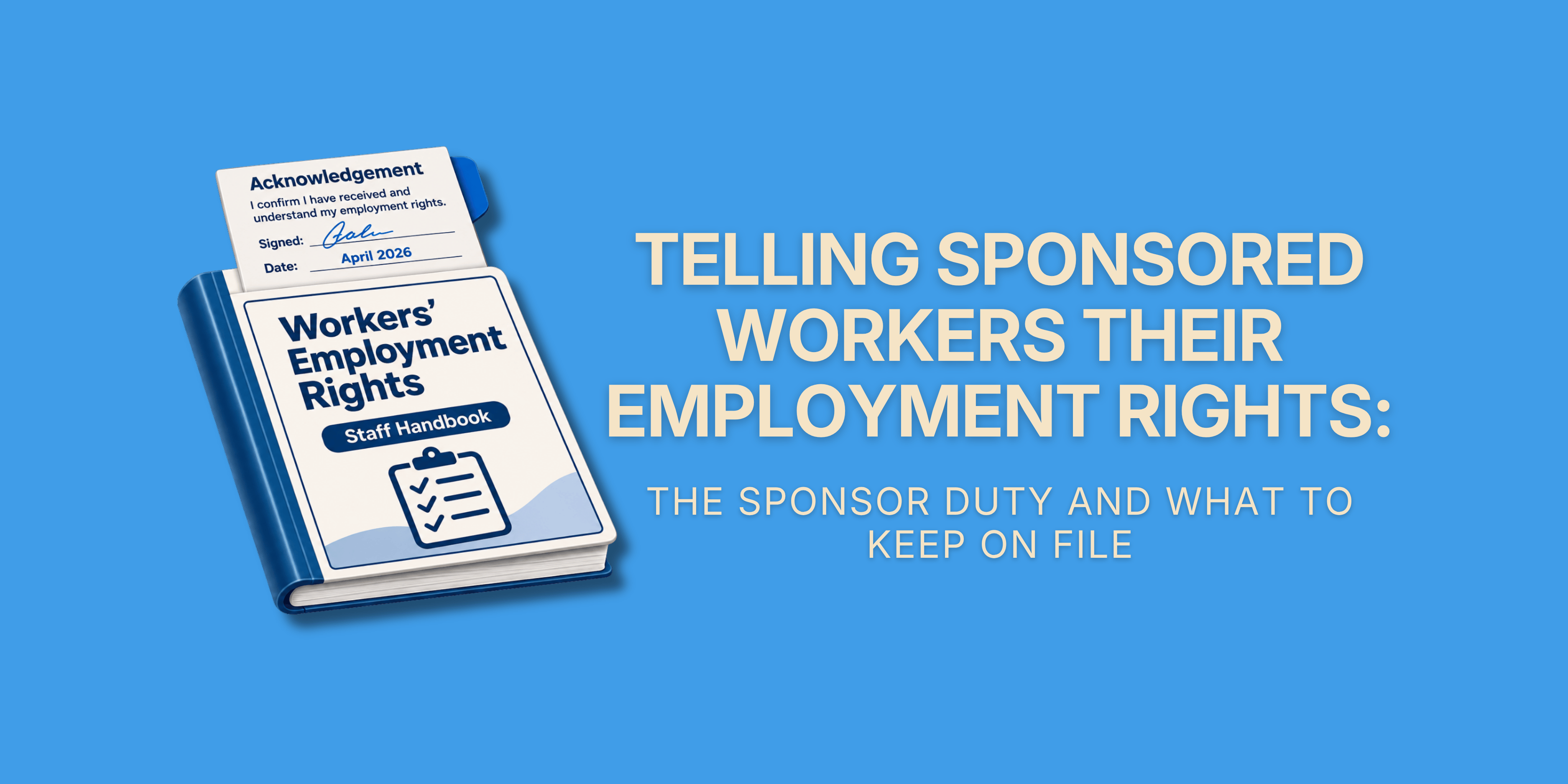
The guidance does not require a signed acknowledgement. We recommend one because it is the only document that links a specific version of the pack to a specific worker on a specific date. It should record:
- The worker's name, employee number and CoS reference, so the record ties back to the sponsor file.
- The pack version and date, and the sections issued (for a partial reissue, only the sections that changed).
- How it was given: in person, by email or through a staff portal, and who gave it.
- The date of any induction session or one-to-one walkthrough, and whether an interpreter or translated copy was used.
- A plain statement that the worker has received the information, has had the chance to ask questions and knows where to find it again.
- Signatures and dates from the worker and the HR officer, and the next review date.
Language and understanding
The guidance does not require translation. The duty is that workers understand their rights, though, and a care worker or chef reading a dense HR document in a second language may not. A short spoken walkthrough at induction, with the worker invited to ask questions, is the simplest way to meet the standard, and a line on the acknowledgement form is the simplest way to prove it. Plain English helps everyone, including the compliance officer reading your file.
What to Keep in the Appendix D File
Appendix D section 5(l) asks for evidence that you gave sponsored workers information about their employment rights "as set out in section L2 of Part 1". It gives two examples: copies of written information you provided (which could be in the contract) and training or awareness courses. For each sponsored worker, we would expect a compliance officer to find:
- The acknowledgement form for each version the worker has received, oldest first.
- A copy, or a clear reference, of each pack version issued, so you can show exactly what the worker was told on a given date. Keep superseded versions centrally as well as on the file.
- Induction or training attendance records covering the eight areas.
- From 2027, the record of each trade union statement given or made available, with the date and method.
Not all evidence carries equal weight. In our view a signed acknowledgement of a dated, versioned pack is the strongest; a training record with attendance comes next; a contract clause on its own is the weakest. Appendix D accepts the contract, but a clause signed in 2023 cannot show the worker was told about rights that changed in 2026.
Retention follows the general Appendix D rule: keep the documents throughout sponsorship and until one year after sponsorship ends, or until a compliance officer has examined and approved them if that is sooner. Paper or electronic storage are both acceptable, but you must be able to produce the documents on request. Failing to produce an Appendix D document within the time limit is itself a revocation ground under Annex C2(g), so a record you cannot find quickly is nearly as bad as no record. Your wider retention policy may require longer for employment law purposes.
How a Compliance Officer Would Test It
Part 3 paragraph C7.15 lists what a compliance officer may do on a visit or a digital compliance check. Two items matter here: they may speak to any sponsored worker, and they may inspect records and systems to check you are following your obligations, including Appendix D. Visits can be announced or unannounced (C7.9), and the Home Office also runs regular checks with HMRC on what you pay (C7.7). Put together, that gives an officer five ways to test this duty.
| Test | What the officer looks at | What a pass looks like | Where a fail leads |
|---|---|---|---|
| 1. Produce the evidence | The Appendix D file for a sample of sponsored workers. | A dated, versioned acknowledgement for each worker, produced quickly. | Annex C2(g) if not produced on request within the time limit. |
| 2. Explain the process | Who issues the pack, when, how it is updated and who checks it (L2.7 "systems or processes"). | A written procedure with a named owner and dated reviews. | Annex C2(b): no processes and systems to comply. |
| 3. Interview the worker | Whether the worker can describe their pay rate, hours, holiday, how to raise a grievance and union rights in their own words. | The worker can explain the basics and knows where to look. | Annex C2(a): failure to meet a C1 duty, and doubt over the rest of your file. |
| 4. Compare the pack with reality | Payslips, rotas, HMRC data and the CoS. | The pack matches what the worker is actually paid and asked to work. | Underpayment can move into Annex C1(aa) (paying less than the CoS states), which is a mandatory ground. |
| 5. Check it is current | The version date against rate changes and new rights. | Pay section reissued after each April change; trade union statement on file from 2027. | Weak evidence under tests 1 and 3, and a sign the process is not working. |
The worker interview is where most sponsors are exposed. Do not script answers. An officer can tell when a worker is reciting, and a coached answer damages credibility more than an honest "I would check the handbook or ask HR". What you want is a worker who remembers the walkthrough, knows the document exists and knows who to ask. Our compliance visit checklist covers how to prepare staff for interviews without coaching them.
What happens if the duty is not met
Failing this duty is a "normally revoke" ground, not a mandatory one. On the current Part 3 (version 08/26) the routes are Annex C2(a) (failure to comply with any section C1 duty, which includes C1.53; our sponsor duties checklist lists the rest), C2(b) (not having the processes and systems to comply) and C2(g) (failing to produce an Appendix D document on request). Under C8.5 and C9.8 the Home Office will first consider downgrading a licence for an Annex C2 matter, and may suspend instead where breaches are sustained or, taken together, show a systematic failing.
Some 2026 commentary described "a new mandatory ground for revocation" alongside the employment rights duty. That ground is Annex C1(oo): reasonable grounds to suspect your organisation exists mainly to facilitate someone's entry or residence. It is unrelated. The employment rights duty itself appears nowhere in Annex C1. The real mandatory risk lies underneath it: if the information is wrong because the pay is wrong, a sponsored worker paid less than their CoS states falls under Annex C1(aa). Our guide to suspension, downgrade and revocation explains how each annex is applied.
Keeping the Pack Current: A Review Cycle Tied to the Employment Rights Act
The Home Office duty has not changed since March 2026. The rights it asks you to explain are changing on about ten dates between now and the end of 2027. A pack issued once and filed is out of date within months. The table sets out the dates that touch the pack, with the legal status of each on 19 November 2026. The full list, with every commencement regulation, is in our Employment Rights Act 2025 timeline.
| Date | What changes | Status on 19 November 2026 | Pack action |
|---|---|---|---|
| 1 April 2026 | Minimum wage rates: £12.71, £10.85, £8 | In force (SI 2026/357) | Check any pack issued in March was updated. |
| 6 April 2026 | Statutory Sick Pay from the first qualifying day; day-one paternity and unpaid parental leave | In force (sick pay: SI 2026/373) | Section 6 must reflect both. |
| 30 October 2026 | All reasonable steps to prevent sexual harassment; third-party harassment | In force (SI 2026/1065) | Update section 9 now. |
| 1 January 2027 | Statement of trade union rights for new starters | Regulations made (SI 2026/1193), in force 1 January 2027; section 136A duty awaiting a commencement regulation | Add the prescribed statement to the new-starter pack as a separate document. |
| 1 January 2027 | Unfair dismissal qualifying period cut to six months | Confirmed (SI 2026/559) | Check probation wording in section 2. See our unfair dismissal guide. |
| 1 January 2027 | Strengthened tipping law | Announced (government timeline); no commencement regulation found | Hospitality: draft the tips wording, issue when confirmed. |
| 1 April 2027 | Minimum wage rates: £13.21, £11.27, £8.31; accommodation offset £11.53 | Accepted by the Government on 28 October 2026; amending regulations not yet made | Reissue section 3 before 1 April 2027. |
| By 5 April 2027 | Statement of trade union rights for existing workers | Regulations made (SI 2026/1193) | Give or make available to every existing worker. |
| March to October 2027 | Fire and rehire (March), bereavement leave (April), flexible working (October) | Announced only, per the government timeline updated 5 November 2026 | Update when regulations are made. |
| Every year by 5 April, from 2028 | Annual trade union statement | Regulations made | Annual reissue or a written notice of where it is. |
A review rhythm that works
Fixed dates first. Put 1 January, 1 April and 5 April in the HR calendar every year: they cover the minimum wage, most statutory pay uprating and the trade union statement. Then event triggers: a new version of Part 1, Part 3 or Appendix D, a new Employment Rights Act commencement regulation, a change to your own policies, or a change in which unions you recognise or have an access agreement with. Finally, person triggers: a new CoS, an extension, a change of role, a move to a new site or a return from long absence. On each trigger, reissue only the sections that changed and record that partial issue on the acknowledgement form.
Give the pack one owner in HR, and have the Authorising Officer sign off each new version. The Authorising Officer is responsible for the sponsor's compliance, and a dated sign-off is the simplest answer to test 2 in the table above.
The Trade Union Statement from January 2027 Is a Separate Duty
From 1 January 2027 there are two different trade union obligations, and they should not be merged. The sponsor duty in L2.6 asks you to ensure sponsored workers understand union membership rights, in your own words. The new statutory duty in section 136A of the Trade Union and Labour Relations (Consolidation) Act 1992, inserted by section 58 of the Employment Rights Act 2025, requires every employer to give every worker a written statement that they have the right to join a trade union. It applies to all workers, sponsored or not.
The detail is in the Statement of Trade Union Rights Regulations 2026 (SI 2026/1193), made on 12 November 2026, laid on 16 November 2026 and in force on 1 January 2027. The points HR needs:
- The form is prescribed. The statement must follow the government form in the Schedule. You may add only what the Regulations require, such as the unions you recognise or have a statutory access agreement with, and a link to, or copy of, the Certification Officer's list of trade unions. Nothing else may be added or changed, so keep it as a separate document in the pack.
- New starters from 1 January 2027 must receive it at the same time as their written statement of employment particulars, in person, by post or electronically.
- Existing workers employed before 1 January 2027 and still employed on 5 April 2027 must receive it, or be told in writing where it is available, by 5 April 2027.
- Every year after that, by 5 April, it must be given again or kept continuously available with a written notice headed "Availability and location of statement of trade union rights".
- Changes to recognition or access agreements require an updated statement within one month.
- Enforcement is through section 38 of the Employment Act 2002: where a worker wins certain tribunal claims and the statement was not given, the tribunal can award two or four weeks' pay.
Status: the Regulations are confirmed law from 1 January 2027. Section 58 of the 2025 Act, which creates the duty itself, was in force on 19 November 2026 only for the purpose of making regulations, and we found no commencement regulation bringing the duty into force. The government timeline lists it for 1 January 2027. Prepare for that date and check for the commencement order before you rely on it. The Regulations extend to England, Wales and Scotland, not Northern Ireland. For the separate union right to enter workplaces, see our trade union right of access guide.
Common Mistakes
- Relying on a contract clause alone. It satisfies the letter of Appendix D on the day it is signed, and nothing after that.
- Issuing to new starters only. Workers sponsored before March 2026 are covered and are the most likely to have no record.
- Treating it as a one-off. A pack dated March 2026 already misses the October 2026 harassment changes and will miss the April 2027 rates.
- Editing the trade union statement. From 2027 the statutory form must not be changed, so it cannot be rewritten into your house style or folded into the handbook text.
- Putting immigration advice in an HR document. Keep the pack to employment rights and send visa questions to a regulated adviser.
- Coaching workers for interviews. It is visible, and it turns a records question into a credibility question.
How Can WPC HR Help?
WPC HR, the HR-tech arm of WorkPermitCloud Ltd, helps UK sponsors issue, record and evidence the employment rights information that Part 1 of the sponsor guidance requires, through its HR compliance software and its sponsor licence compliance audit.
The software includes worker rights duty support: guidance on issuing and recording the required worker rights notice, updates shared through the WPC HR subscriber group, and records kept in each worker's Appendix D file. Worker files are organised around the Appendix D record-keeping list, employee records for sponsored and non-sponsored staff sit in one place, and the compliance dashboard shows your sponsor duties and worker records on one screen, alongside visa expiry reminders at 90, 60 and 30 days.
If you want to know whether your current pack and files would survive a visit, our sponsor licence compliance audit reviews your record keeping against Appendix D and runs a mock compliance visit, testing your processes and questioning your Authorising Officer the way a compliance officer would, with a prioritised report on what to fix first.
| Get in touch with our team via our contact page. 📞 Call us: 020 8087 2343 📧 Email: info@workpermitcloud.co.uk 📅 Book a free compliance audit: wpchr.co.uk/sponsor-licence-compliance-audit 🔗 See the platform: wpchr.co.uk/hr-compliance-software-features |
Conclusion
The employment rights duty is one of the simplest sponsor duties to meet and one of the easiest to fail by neglect. It covers the workers you sponsor, including those sponsored before March 2026. It needs information on eight named areas, given in a way the worker understands, and evidence on each Appendix D file. Issue a dated, versioned pack with an acknowledgement, keep one owner for it, and reissue the parts that change on 1 January, 1 April and 5 April each year. Do that and a compliance officer will find a file that matches what your workers say, which is the whole test.
Glossary
| Term | Definition |
|---|---|
| Acas | The Advisory, Conciliation and Arbitration Service, which publishes employment rights guidance for England, Scotland and Wales and is named in L2.6. |
| Annex C1, C2, C3 | The three lists in Part 3 of the sponsor guidance setting out when the Home Office will revoke (C1), will normally revoke (C2) or may revoke (C3) a sponsor licence. |
| Appendix D | The part of the sponsor guidance listing the documents a sponsor must keep for each sponsored worker, and for how long. |
| Authorising Officer | The senior person with overall responsibility for an organisation's activity as a licensed sponsor. |
| B-rating | A downgraded licence rating, usually with an action plan the sponsor must complete to return to an A-rating. |
| Certificate of Sponsorship (CoS) | The electronic record a sponsor assigns to a worker, stating the job, salary and other details the worker's application relies on. |
| Certification Officer | The statutory regulator of trade unions in Great Britain, who keeps the public list of trade unions the new statement must point to. |
| Compliance check | A Home Office check on a sponsor, made on site or digitally, which may include interviews with sponsored workers. |
| L2.6 and L2.7 | The paragraphs of Part 1 of the sponsor guidance that set the worker rights and welfare duty and the requirement to evidence it. |
| Labour Relations Agency | The Northern Ireland body that provides a similar service to Acas. |
| National Minimum Wage and National Living Wage | The legal minimum hourly pay rates; the National Living Wage is the rate for workers aged 21 and over. |
| Pension auto-enrolment | The legal duty on employers to enrol eligible workers into a workplace pension, with a right for the worker to opt out. |
| Principal statement | The main part of the written statement of employment particulars, due on the first day of employment. |
| Recognised trade union | A union an employer recognises for collective bargaining; it must be named in the statutory statement from 2027. |
| Sponsored worker | A person sponsored, or to be sponsored, on a Worker or Temporary Worker route; the sponsor guidance calls them a "worker". |
| Statement of trade union rights | The government-drafted written statement, required under section 136A of the 1992 Act and SI 2026/1193, telling workers they have the right to join a trade union. |
| Statutory access agreement | An agreement under the 1992 Act giving a trade union access to a workplace; it must be named in the statutory statement. |
| Working Time Regulations | The rules on maximum weekly working hours, rest breaks, night work and paid holiday. |
| Written statement of employment particulars | The document setting out the main terms of employment that every employee and worker must receive, partly on day one and partly within two months. |
FAQ
Frequently asked questions
Yes. Paragraphs L2.6 and L2.7 of Part 1 of the Workers and Temporary Workers sponsor guidance require sponsors to ensure sponsored workers understand their employment rights and to have HR systems or processes that show the information was given. It has applied since the 6 March 2026 guidance refresh and is unchanged in the current version 08/26.
The main text is in Part 1, section L2, under the heading "Worker rights and welfare" (paragraphs L2.6 and L2.7). Part 3 paragraph C1.53 repeats it as part of complying with wider UK law, and Appendix D section 5(l) sets out the evidence you must keep.
The Home Office duty applies to sponsored workers. The glossary defines a "worker" as someone sponsored on a Worker or Temporary Worker route, and both L2.7 and Appendix D refer to workers you sponsor. Your other staff have the same employment rights, so we recommend giving everyone the same pack and keeping the Home Office evidence on each sponsored worker's file.
We advise that you do. The guidance has no transitional rule and L2.7 applies to anyone you currently sponsor, whenever their sponsorship began. Give existing sponsored workers the pack now, record the real date and never backdate the acknowledgement.
The guidance does not prescribe a format. Appendix D gives written information and training or awareness courses as examples of evidence. Because you must be able to prove what you told each worker and when, a written, dated pack with a signed acknowledgement is the practical choice.
Appendix D says the information could be in the contract of employment, so a clause can count as evidence. On its own it is weak, because it cannot show the worker was told about rights that changed after signing, such as the October 2026 harassment changes or the April 2027 minimum wage rates. Use the contract as a starting point and keep a versioned pack on file as well.
L2.6 names eight areas: entitlement to the National Minimum Wage, the Working Time Regulations, pension auto-enrolment and opt-outs, statutory leave and pay, health and safety, trade union membership and the rights of union representatives, your Equality Act duties, and how to raise grievances. The list is not exhaustive.
Keep the signed acknowledgement for each version of the pack the worker received, a copy or reference of each version, induction or training attendance records, and from 2027 the record of each trade union statement. Keep them throughout sponsorship and until one year after it ends, or until a compliance officer has approved them if that is sooner.
Yes, but it is a discretionary ground. Failing the duty falls under Annex C2 of Part 3, where the Home Office will normally revoke but will first consider a downgrade. It is not in Annex C1, the mandatory list. The greater risk is what an investigation can uncover, such as paying a worker less than their CoS states, which is a mandatory ground under Annex C1(aa).
The guidance does not require translation. It does require that workers understand their rights, so where a worker's English is limited, a spoken walkthrough, an interpreter or a translated summary is sensible. Record what you did on the acknowledgement form.
No. It is a separate legal duty on every employer for every worker, under section 136A of the 1992 Act and the Statement of Trade Union Rights Regulations 2026. It uses a government-drafted form that you must not edit. Give it to new starters from 1 January 2027 and to existing workers by 5 April 2027, then every year by 5 April. The commencement regulation for the duty itself had not been made on 19 November 2026.
At least on 1 January, 1 April and 5 April each year, and whenever the sponsor guidance, an Employment Rights Act commencement regulation or your own policies change. Reissue only the sections that changed and record the partial issue.
Expect simple questions: how much they are paid and how often, their hours and holiday, how they would raise a concern or grievance, and whether they know about union membership. Officers may speak to any sponsored worker under Part 3 paragraph C7.15. A worker who can explain the basics in their own words and knows where to find the pack is what you are aiming for.